
Jesus refused to turn stones into bread even though he was hungry. He refused to jump from the steeples of the church even though the spectacle of angels guarding him from getting hurt would have earned him much reputation as a miracle worker.
For his super-human qualities, consistently and unequivocally, Jesus refused to perform anything sensational and spectacular. While he was on the cross, his accusers taunted him with an offer: ‘Come down from the cross and we will believe you’. But Jesus did not.
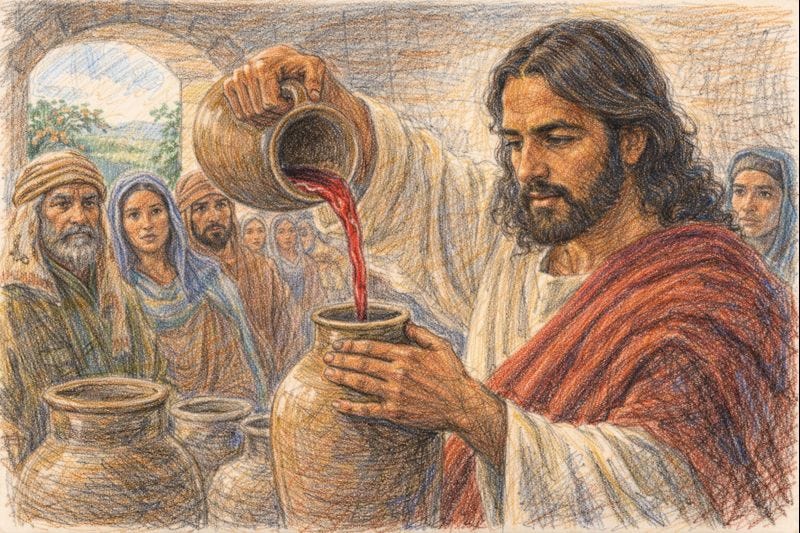
Yet, while rejecting the sensational, he did turn water to wine. How do we account for that miracle? How do we understand the inclusion of such miracle stories in the Gospels?
Those which have generally been described as miracles of Jesus were not stunts or events that would make the laws of nature stand on its head; but they were signs as John names them in his gospel. We read:
‘What Jesus did here in Cana of Galilee was the first of the signs through which he revealed his glory; and his disciples believed in him.’ (Jn. 2.11)
Signs are indicators of something more important or significant. In the Gospels, signs are events through which God’s glory, God’s nature, and God’s activity are revealed.
Jesus always tried to turn people’s attention away from himself and towards God his Father, and the radical transformation God would bring into our lives and our world. Miracles were pointers to the in-breaking of God’s rule into our lives.
Secondly, they were acts of compassion. The miracles, particularly the healing miracles, were occasions when Jesus moved with compassion, reached out, and made the lives of people whole.
Thirdly, they were often parables, intended to convey a truth which one could not communicate otherwise.
The context of Jesus turning water to wine is that of a marriage feast, an occasion when the union of two persons and two families are celebrated with the community in acts of sharing and caring for one another.
It is all about love: its joy, its celebration. Marriage, in fact, extends and expands the boundaries of our love to include many more families and friends. Hence, the Kingdom of God is often likened to a wedding feast.
This event occurred on the third day: ‘On the third day a wedding took place at Cana in Galilee.’ (Jn. 2:1)
The ‘third day’ signifies resurrection; the story is about resurrection and new life; resurrection guarantees that God’s rule and the fullness of life will be a reality; that the death dealing forces will not have the last word and that life will triumph over death.
The miracle here is about turning water, filled in jars for ceremonial washing, into wine. Ceremonial washing is related to the Jewish religion.
Jesus turns the ritualistic and legalistic religion of Judaism into a spirituality that celebrates God’s love and God’s rule. He came to make our life complete, give fullness of life, and give a new purpose and meaning for our lives.
He came to transform religion resting on purification rites and ceremonial rituals into a spirituality rooted in humble obedience.
Jesus turned the water of ritualistic and legalistic religion into the wine of a spirituality rooted in utter dependence on God and obedient service to God.
We read in Jn. 2: 6-9: ‘Nearby stood six stone water jars, the kind used by the Jews for ceremonial washing, each holding from twenty to thirty gallons.’
‘Jesus said to the servants, ‘Fill the jars with water’; so they filled them to the brim. Then he told them, ‘Now draw some out and take it to the master of the banquet.’ They did so, and the master of the banquet tasted the water that had been turned into wine.’
But before Jesus did this, he had reacted to his mother’s request to help the family, as they had run out of wine. Jesus challenged his mother to move beyond the popular expectations placed on the Messiah: one who would fulfil all their material needs and liberate them by spectacular interventions with supernatural powers.
‘When the wine was gone, Jesus’ mother said to him, ‘They have no more wine.’ Jesus replied, ‘Woman, why do you involve me? My hour has not yet come.’ (Jn. 2: 3-4)
Jesus’ reply to Mary would appear very rude. We cannot fault him for calling his mother ‘woman’, as that was an endearing and respectful way of addressing a senior lady.
But the more difficult and inconvenient was the question that Jesus asked: ‘why do you involve me?’ Jesus dissociates himself from any obligation to respond to the expectations of Mary and the demands associated with it.
On one occasion, when Jesus’ mother and brothers were searching for him, Jesus told the crowd: ‘Who is my mother, and who are my brothers?’ Pointing to his disciples, he said: ‘Here are my mother and my brothers! For whoever does the will of my Father in heaven is my brother and sister and mother.’ (Matthew. 12: 48-50)
At the foot of the cross, we find Jesus inducting his mother and the disciple into a new relationship: ‘When Jesus saw his mother and the disciple whom he loved standing beside her, he said to his mother, ‘Woman, here is your son.’ Then he said to the disciple, ‘Here is your mother.’
For Jesus, everything, including family ties, must be subordinated to the work that he has been sent to do.
Jesus refuses to work with the demands of blood relationship; in the kingdom of God, what matters is not blood relationship but the demands of love. Love does not confine itself to blood relationship. It reaches out to those who are in real need.
That is why Jesus told the Pharisees and the doctors of the law: ‘When you give a luncheon or dinner, do not invite your friends, your brothers or sisters, your relatives, or your rich neighbours; if you do, they may invite you back and so you will be repaid.’
‘But when you give a banquet, invite the poor, the crippled, the lame, the blind, and you will be blessed. Although they cannot repay you, you will be repaid at the resurrection of the righteous.’ (Lk. 14: 12-14)
Jesus is not one who can be brought around to resolve all situations of lack created by human greed, selfishness, and absent diligent planning and responsible action. Jesus is not a miracle worker.
The second part of his statement makes that amply clear. Jesus said: ‘My hour has not yet come.’ ‘My hour’ refers to the crucifixion of Christ. The supreme miracle, in John’s gospel, is Jesus’ laying down his life on the cross for us.
The act of turning water into wine is not achieved through some cheap gimmick but by the sacrificial offering of oneself, exercising and fulfilling the obligations and responsibilities of love in total self-giving.
It is costly; it meant for Jesus confronting death dealing forces in the world and remaining in solidarity with those who were poor and downtrodden. It meant taking up the cross.
The new wine and the new spirituality that Jesus offers to us is the transformation of us into a new community bound by the obligations of love and responsibility for our fellow human beings and the rest of creation.
Lastly, the act of turning water into wine is achieved through total surrender in obedience to the will of God in Jesus Christ.
His mother said to the servants: ‘Do whatever he tells you.’ Then we read: ‘Jesus said to the servants, ‘Fill the jars with water’; so they filled them to the brim.’
Have you ever thought what would have happened if the servants had refused to fill the jars? Would the water become wine?
There was no prayer, no word of command, no hysterical shouting, no laying of hands, no binding of Satan, nothing that you would see in a miracle crusade. He did not even touch the water. He did not even taste it afterward to see if it had really turned into wine.
He simply said: ‘Take it to the master of the ceremonies.’ The water simply became wine.
How did it happen? The servants acted in complete obedience; they did what Jesus asked them to do: fill the jars with water. Jesus replaces religion and its ritualism and legalism with a new spirituality of committing oneself to doing God’s will in history.
The hallmark of this new wine, this new spirituality, is love and obedience, self-giving, sacrificial love in obedience to God.
The miracle of turning water into wine is still a possibility if we are prepared to commit ourselves in total surrender to do his will. We can fill water jars; only God can turn water into wine.
We can do the ordinary, the commonplace, the routine, but God touches it and brings it to life and gives it flavour, fragrance and effect. But this intervention of God will not happen if we do not fill the jars.
There is no brilliant stroke that is going to transform water into wine except through our surrender in total obedience to God in Jesus Christ. ‘To turn water into wine, what is common into what is holy, is indeed the glory of Christianity.’ (F. W. Robertson)
But it calls for our obedience, our participation in the sacrificial life of our Lord Jesus Christ. As we partake in the body and blood of Jesus Christ, we offer ourselves for this miracle to happen in our life and in the life of the world around us.