
Transfiguration
About eight days after Jesus said this, he took Peter, John and James with him and went up onto a mountain to pray. (Lk 9:28)
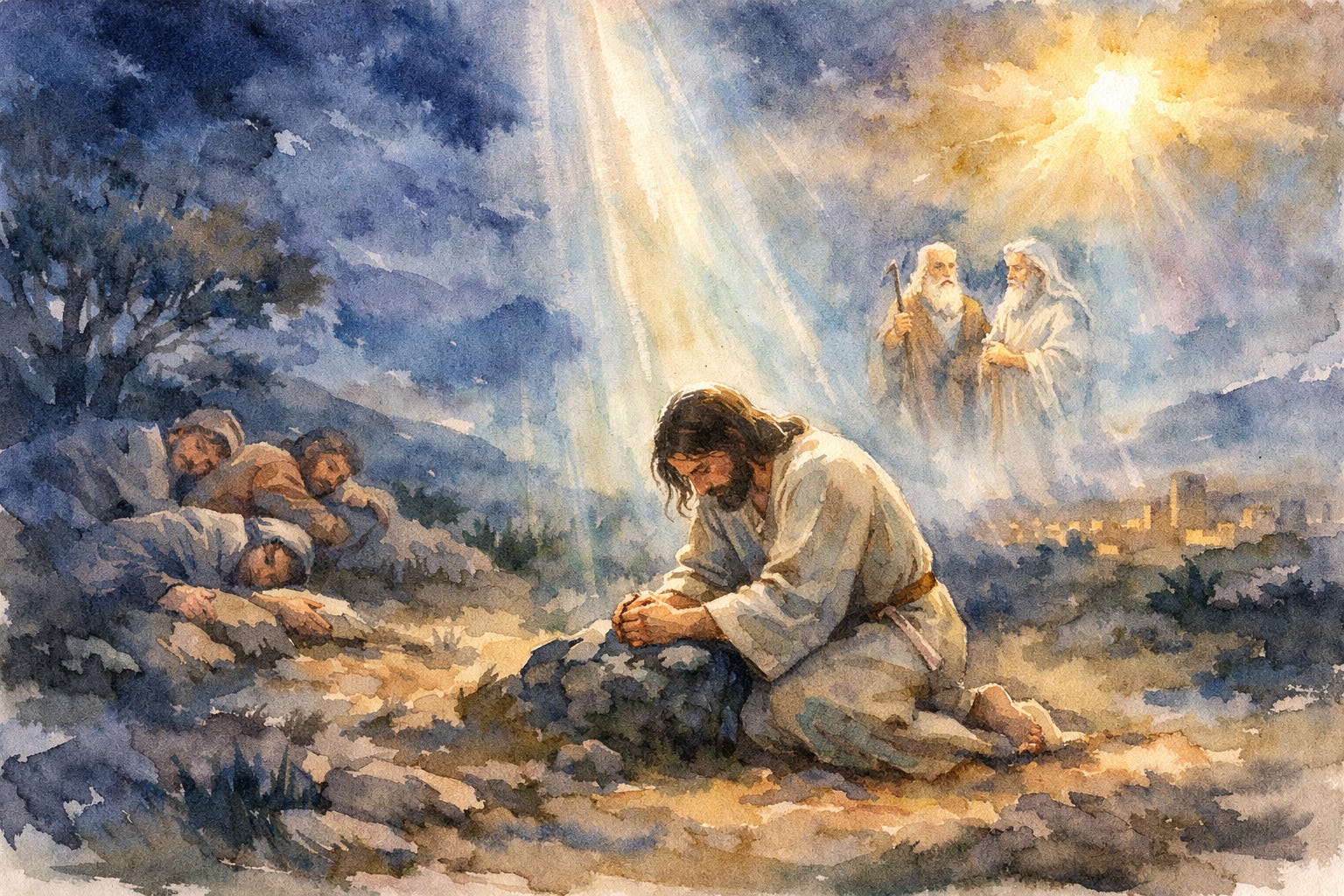
Whenever Jesus was confronted with uncertainties as to how he should fulfil his God-given mission, whenever he was beset with temptations of power and fame, whenever he was tempted to take the easy way, whenever he felt that the mission was beyond his capability, whenever he wanted to make crucial decisions in life, Jesus departed into a solitary place and prayed. Here we find Jesus going up to a mountain to pray.
Today, many regard prayer as simply asking God for things: approaching God with a ‘shopping list’. This is anything but what prayer should be.
Rather, it ought to be a dialogue, a two-way communication, between humans and God, where one’s existential concerns are placed before God and God’s will is sought in the midst of them to live a fulfilling life according to His will. Prayer for Jesus, as recorded in Luke’s Gospel, was an occasion when he was empowered for his divine mission. It was an occasion when Jesus opened himself to the will of God.
Jesus took with him Peter, John and James. Jesus wanted a community to share in his ministry and suffering: he selected a small group from among the disciples, a more intimate group: Peter, John and James. When Jesus had gone to cure the daughter of Jairus, he had the same group of disciples with him (Lk 8:51).
We find Peter, John and James again in Gethsemane, as Jesus was going through extreme mental agony as to how he would fulfil the ministry entrusted to him and what it would involve.
Jesus needed the intimacy of this fellowship and we also needed it. The Church is that fellowship, that intimate community that is willing to share in the mission of Christ and in his suffering for the world. But unfortunately, the disciples failed to realise it. Today, as a Church, we have also failed to share in Jesus’ agony for the world.
“As he was praying, the appearance of his face changed and his clothes became dazzling white.” (Lk 9: 29) Jesus was transfigured. The disciples saw two men, Moses and Elijah, talking to Jesus. They appeared in heavenly glory.
Jesus was found to be having a conclave with two prominent figures in the history of the people of Israel, Moses and Elijah, representing the law and the prophets. They were speaking of His death, His departure, his exodus from the world, which He was about to accomplish in Jerusalem. Jesus’ crucifixion was presented here not as a fate that was thrust upon him, but rather as something that Jesus willingly accepted in consultation with those who represented the historical legacy of Israel, God’s plan of salvation.
Prayer, essentially, was this form of consultation with God and seeking out God’s plan for one’s life and committing oneself to live according to it. Jesus knew that there was no easy way to fulfil one’s responsibility to one’s fellow human beings and the world, to redeem God’s creation from the evil one. It was a moment of decision for Jesus.
The adversities that come as part of our existential reality: diseases, accidents and death, cannot be described as experience of the Cross. They are inevitable eventualities of human life.
The Cross refers to the sufferings that become our portion due to the decisions and actions that we take in faithfulness to our divine calling. For Jesus, these were not easy decisions; he wanted the fellowship of his disciples, his friends; he wanted the counsel and support of those saintly souls that represented his historical consciousness: Moses and Elijah. He wanted the divine light, so that he could see his present predicament from God’s perspective.
While Jesus was engaged in this very important conclave and taking a very crucial decision to follow the path of the Cross and confront the powers that be, what was the condition of the disciples? First, they were weighed down with sleep. The chosen people of God were found sleeping in the past; they are found sleeping in the present amidst the onerous responsibilities of participating in God’s concern for the world.
While the ship was tossed about in the rough sea and it was about to break and the mariners were afraid and each cried to his gods, Jonah, the prophet of Yahweh, the Lord of heaven and earth ‘who made the sea and the dry land’, was fast asleep deep down in the hold of the ship. (Jon 1: 4-10) He had to be rebuked by the Captain of the ship: “What are you doing, sound asleep? Get up, call your God!”
We find Peter, James and John sleeping in the garden of Gethsemane, unable to keep awake and share in the agony of Christ for the world. Jesus asks Peter, “Simon, are you asleep? Could you not keep awake and pray that you may not come into the time of trial?” (Mk. 14:37)
Second, at the mount of transfiguration the disciples were basking in this experience of divine glory and wanted to continue in it. Jesus, the company of Moses and Elijah, their dazzling white robes and the glory that shone around were too good that they made it an end in itself and decided to institutionalise it. “Master, it is good for us to be here; let us make three dwellings one for you, one for Moses and one for Elijah”, they said to Jesus. Today most of us are after such ecstatic religious experiences. Charismatic movements thrive on people’s need for emotional high.
When such subjective experiences become an end in themselves, and we seek after them and bask in them, then, they become another form of idolatry. We substitute these experiences for God and his mission in the world.
We forget our mission to the valley, where people are clamouring for healing and wholeness, where people are dying of the pandemic; where the poor are trucking and dying in the highways on their homebound journey. Rescuing them means hard toil and dirtying our clothes, and confronting the demoniacal forces, including the powers that be. That would even mean death and suffering; that would be costly.
Third, we find their incomprehension of the mission of Christ. They tried to consolidate their experience of transfiguration in certain institutional structures and enjoy it forever, not knowing what they said. They never comprehended the true meaning of discipleship or the true meaning of the mission of Christ in the world. Almost like in a trance they were jabbering, overwhelmed by the experience of divine glory and not realising its import for the mission of Christ.
It is this incomprehension of the disciples, their blindness to the mission of Christ and their unwillingness to confront the forces of evil that grieved the heart of Christ. The passion narrative is replete with such instances of incomprehension on the part of disciples regarding the mission of Christ.
In another instance, when Jesus was trying to impress upon the disciples about his confrontation with the religious leaders of his time and his death at their hands, the disciples were fighting over who among them would be the greatest in the kingdom of heaven and who would be seated on the left and the right of Jesus Christ when He comes in glory.
Christ’s disciples were bickering for positions and power; they were basking in the religious experience; they were most often found sleeping oblivious to the sufferings of the world. They never understood the meaning of bearing the Cross. The disciples of today are no different from those of yester years. We continue to cause pain and agony to Jesus. But yet, he seeks our fellowship, our love, our understanding and our participation in his suffering for the world.
The event of transfiguration answers the question, “Who is Jesus?” As we find in Luke Chapters 8 and 9, there are several people who have raised this question. In Luke 8: 25, the disciples ask: “Who is this? He commands even the winds and the water, and they obey him.” Luke records Herod saying: “I beheaded John. Who, then, is this I hear such things about?” (Lk 9: 9)
In Luke 9:18, we find Jesus asking the same question to his disciples, “Who do the crowds say that I am?” Finally, Jesus turned to Peter and asked him, “But who do you say that I am?” Peter gave the answer, “The messiah of God”.
On the mount of transfiguration, God answers this question and declares who Jesus is: “This is my Son, whom I have chosen; Listen to him.” God gives Jesus His stamp of approval and authority. Jesus as the Son of God who stands in the line of Moses and Elijah, carrying the burden of history and leading the world out from slavery to sin and death into freedom and life. The Greek word used for departure means exodus. In Jesus, we have been given a new exodus. Are we prepared for this journey to freedom by listening to him and following him?
Just like Jesus’ intimate circle of disciples, we have got him wrong; we also remain ignorant of the true mission of Christ and the liberation that he brings to us. He brings salvation and healing to us, not by might, but by love and suffering.
Instead of basking in the transfiguration experience, are we prepared to follow him to the valley, where the real battle is fought: the valley of suffering and death? A great crowd awaits us there. They expect us to exorcise demons that possess people, make people convulse and shriek, and maul them and scarcely leave them. Are we ready to take up that challenge? We are called for this task. “This is my Son, whom I have chosen”; “Listen to him”.