
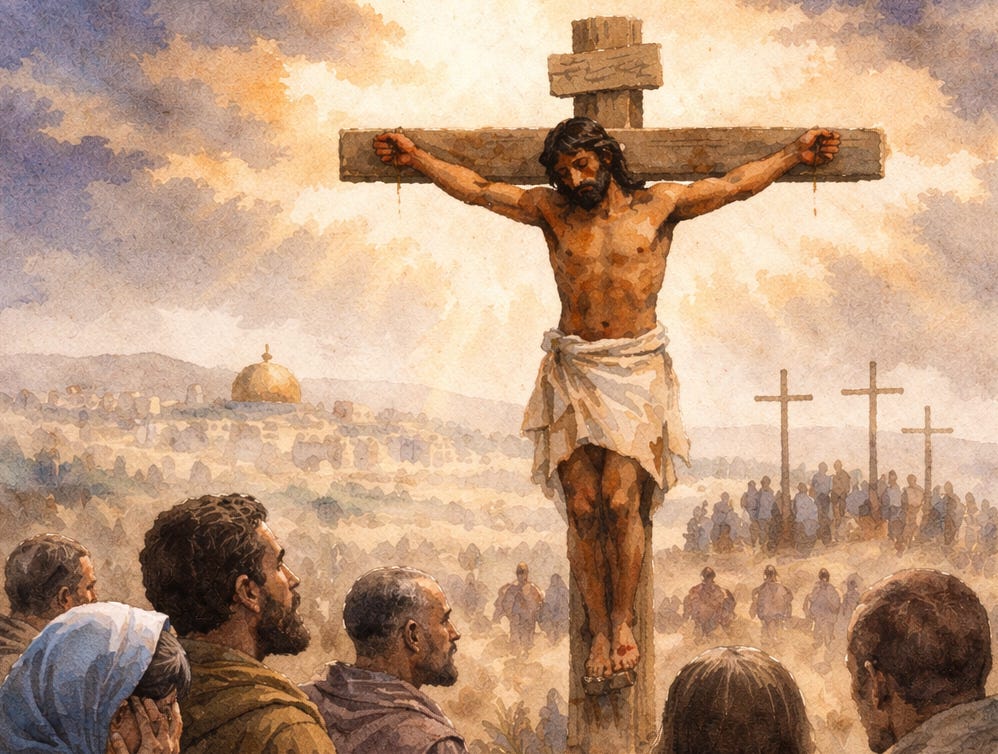
Jesus in Solidarity with the World and Humanity
When they came to the place called the Skull, they crucified him there, along with the criminals—one on his right, the other on his left. Jesus said, “Father, forgive them, for they do not know what they are doing.” (Lk 23: 33 & 34)
The first and last words from the Cross begin and end with a prayer. Both address God, “Father”. The first word comes out of utter self-forgetfulness. At a moment of excruciating mental and physical agony, betrayal, and loneliness, there is no shrieking, cursing, or spitting but prayer. At a moment of extreme crisis, as he had been all throughout his life, he enters into a profound communion and fellowship with his Father.
At a time when one would be intensely self-preoccupied, Jesus prays for his enemies, those who crucified him. According to F B Meyer, one of the noted preachers of yesteryears, “in uttering this first cry from the Cross, our Lord entered that work of intercession which he ever lives to continue on our behalf. He thinks, not of himself, but of others; he is occupied, not with his own pain, but with their sins. He makes no threat but instead offers a tender prayer of pleading intercession.”
Who are the subjects of our prayers? How often do we enter into such deep communion with God in complete surrender of ourselves to God and His will?
“Father”, “Abba”, was the most endearing way that Jesus addressed God, his Father. Through him we are also being adopted as children of God and have been given the privilege to cry, “Abba, Father.” Jesus taught us to pray, “Our Father who art in heaven”. Jesus prayed, “I praise you, Father, Lord of heaven and earth…” (Matt. 11:25); “Father, if you are willing” (Lk 22: 42); “Father, into your hands I commit my spirit.” God in Jesus Christ invites us to a deeper and intimate communion with Himself.
Jesus prays that God forgive his detractors as they had crucified him out of their ignorance (they did not know what they were doing). For Luke as well as the New Testament writers, ignorance does not mean a state of mental deficit or lack of knowledge or information but a sinful moral state.
This verse also posits the centre of tragedy in human nature; our ignorance, our spiritual blindness; it was this ignorance that crucified the author of life. In Acts we read, “Now, fellow Israelites, I know that you acted in ignorance, as did your leaders.” (3:17); “None of the rulers of this age understood it, for if they had, they would not have crucified the Lord of glory.” (1 Cor.2:8) This tragic aspect of human ignorance is again re-stated in Romans: “For although they knew God, they neither glorified him as God nor gave thanks to him, but their thinking became futile and their foolish hearts were darkened.”(1:21)
The soldiers who nailed Jesus to the cross and carried out the task entrusted to them, the Jewish leadership who deliberately planned and executed the act of eliminating Jesus, the Roman rulers who, because of the pressure of maintaining law and order, despite knowing that Jesus was innocent, sentenced Jesus to an ignominious death – they were all acting out of ignorance.
It was our self-righteousness, vested interests, pre-judgements, indifference and apathy, anxieties and fears of what would happen to us, lack of courage to stand up to the truth and take sides, our desire for wealth, position and power that crucified Jesus.
As Archbishop William Temple has pointed out, “His enemies were not the notorious sinners whom society casts out… it was not the gross sins such as shock respectable people which sent Jesus to the Cross: it was the respectable sins which are in the hearts of all of us.” (William Temple, Palm Sunday to Easter, pp. 15-16)
Jesus prays that God forgive our most staggering ignorance that led to the crucifixion not only of an innocent man but the very source of life and light. Calvary is where we see the awful depths of human sin but we also see the tremendous heights of God’s love.
Jesus came to bring about forgiveness and reconciliation. Love does not keep an account of wrongs; love forgives. Jesus had this to say to the crowd gathered to listen to him, “Love your enemies, do good to those who hate you, bless those who curse you, pray for those who mistreat you.”(Lk 6: 27-28) To a question as to how many times one should forgive, Jesus replied to the disciples, “I tell you, not seven times, but seventy-seven times.” (Matt.18: 27) Jesus taught his disciples to pray, “Forgive our debts as we forgive our debtors.” (Matt. 6:12) Paul exhorts Christians in Ephesus: “Be kind and compassionate to one another, forgiving each other, just as in Christ God forgave you.”(Ephesians 4:32)
Following Christ, Stephen also prayed for his detractors, “Then he fell on his knees and cried out, ‘Lord, do not hold this sin against them.’ When he had said this, he fell asleep”(Acts 7:60). There is nothing so lovely and nothing as rare as Christian forgiveness. Forgiveness is the first step to reconciliation, to bridge the chasm between God and the humans, between humans among themselves and between humans and the rest of creation. By pleading to his heavenly Father for forgiveness to his detractors, Jesus stands in the gap between God and His creation, and intercedes for restoring them to their rightful relationship with Him.
~ Prayer ~
O Lord, at the foot of thy Cross, I realise that it was the respectable sins in our hearts and society that crucified you. It was our ignorance and spiritual blindness that crucified the author of life. We recognize sin in its most concrete and stark form on the Cross of Christ; it continues to destroy life and disfigure humanity. And yet, your love abounds and you continue to intercede for us; by your forgiveness, you befriend us and invite us to your love and friendship. Help us to follow the example of your forgiving love and continue your ministry of reconciliation wherever we are. Relying on the out-stretched arms on the Cross, I pray.
Amen.