
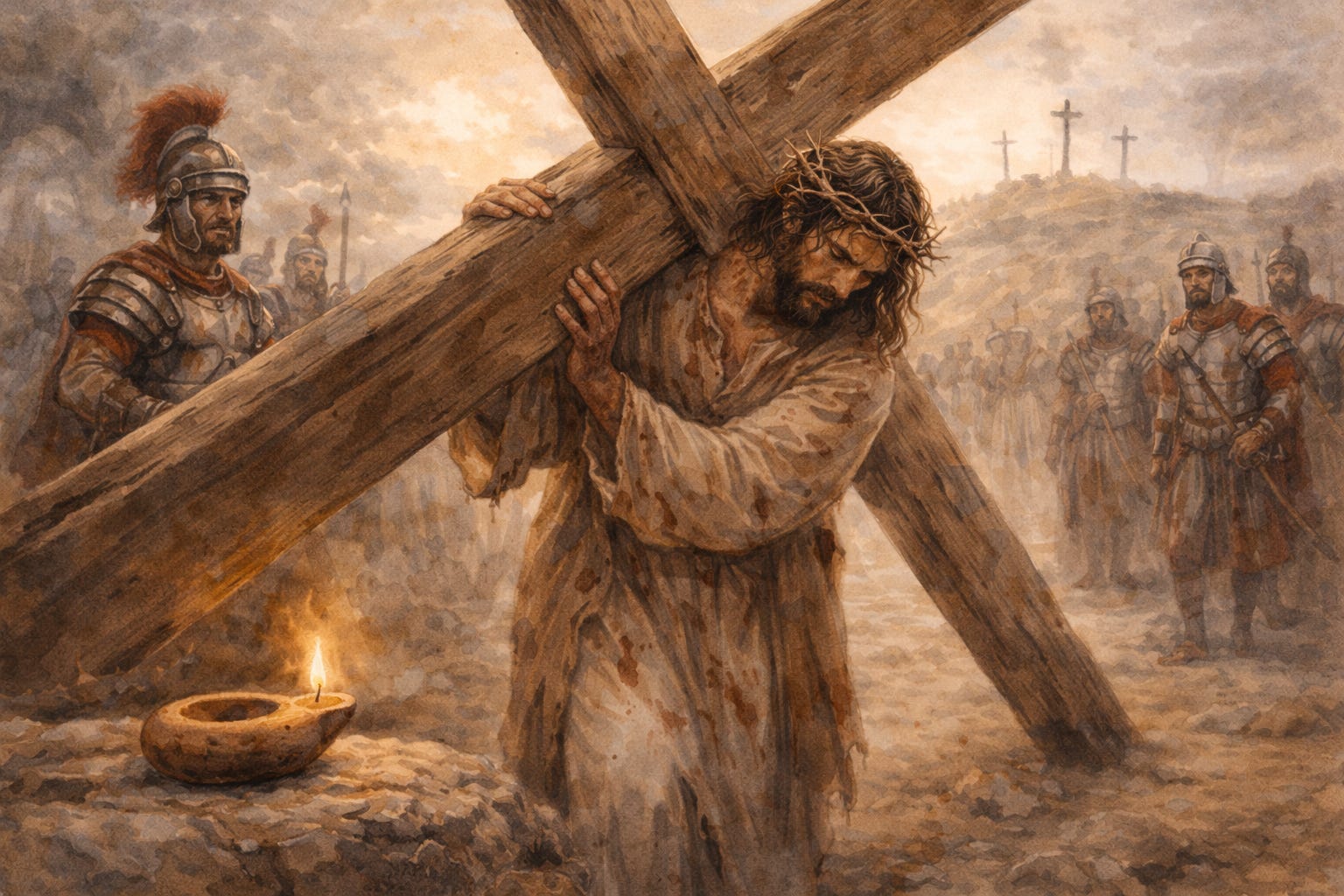
Jesus in Solidarity with Himself
From noon until three in the afternoon darkness came over all the land. About three in the afternoon Jesus cried out in a loud voice, “Eli, Eli, lema sabachthani?” (which means “My God, my God, why have you forsaken me?”) (Matt 27: 45-46, Mk 15:33-34)
This cry from the Cross, emanating from tremendous mental anguish, reveals the perfect humanity of Jesus Christ. This and the next word from the Cross were spoken during the darkness that came over all the land; they were spoken in solidarity with himself from the depth of his suffering.
God, in Jesus Christ, identifies himself with the humanity, in all its brokenness and suffering. All human beings, at one time or the other, would have asked this question, “My God, My God, why have you forsaken me?” This is in fact a quote from Psalm 22: 1. What is being addressed is the question of human suffering, and more than that, the suffering of the just and righteous. Anyone who is committed to doing God’s will in history and taking responsibility for the world and fellow human beings, will go through the same kind of anguish. In fulfilling God’s mission, Jesus passes through disappointment, doubt, loneliness, and the darkest valley; he goes through the experience that God has forsaken him. He experiences the chasm that exists between God and humanity; he stands in the breach and cries: “My God, My God, why have you forsaken me?” (Ezek 22: 30; Is 59: 16)
Even in this suffering, Jesus does not deny his Father, God. Jesus enters with all humankind into the depth of God-forsakenness and asks for the meaning of his suffering. Much of the suffering in our world has no explanation. It is not God’s will that we should suffer. It is commonplace to talk of many adversities of life – separation, death, sickness, sorrow – as God’s will. They are existential realities; but they cannot be described as God’s will. God created the best possible world and gave it to us to manage. But when, as human beings, we play God and disturb God’s order in creation, suffering and death will ensue. The wages of sin is death. There is nothing much God can do about it except to suffer with us and to share in our suffering. This verse affirms that God is with us in our suffering, even when we are left with the feeling of God-forsakenness.
Elie Wiesel, the Romanian born Jewish-American writer and Nobel Prize winner, describes an incident in a Nazi concentration camp. In the incident, two adults and a little boy were being led to the gallows. The little boy had refused to betray fellow inmates who were involved in an act of sabotage and sentenced to death. In his famous work Night (1960), Wiesel narrates the incident as follows:
“The three victims mounted together onto the chairs. The three necks were placed at the same moment within the nooses. ‘Long live Liberty!’ cried the adults. But the child was silent. ‘Where is God? Where is He?’ someone behind me asked. At a sign from the head of the camp, the three chairs tipped over. Total silence throughout the camp. On the horizon, the sun was setting.
The two adults were no longer alive. But the third rope was still moving; being so light, the child was still alive. For more than half an hour he stayed there, struggling between life and death, dying in slow agony under our eyes. And we had to look him full in the face. He was still alive when I passed in front of him. His tongue was still red, his eyes not yet glazed. Behind me, I heard the same man asking: ‘Where is God now?’ And I heard a voice within me answer him: “Where is He? — He is hanging here on this gallows.”
The description of this incident by Elie Wiesel subsequently influenced many Christian Theologians to link Crucifixion and the Holocaust, and to affirm the nature of God’s presence with us, in our history, beset by human sinfulness.
The nature and form of God’s presence in our life and history is being revealed in this cry of total helplessness and God-forsakenness. In the religiously organized Christianity, it is common to attribute superhuman power to Jesus and to attempt to use it to one’s own advantage. The temptations that Jesus had to face at the beginning of his ministry were specifically related to how he could fulfil the mission entrusted to him by his Heavenly Father. J. C. Fenton expresses this dilemma:
“Hands so swift to heal and bless,Feet so ready to speed from city to city,He saved othersWhy not use the same strength?”
This was the question that the Roman soldiers and one of the criminals who were crucified with Jesus disdainfully raised to Jesus on the Cross: “If you are the king of the Jews, save yourself” (Lk 23: 37); “Are You not the Christ?” he asked. Save Yourself and us!” (Lk: 23: 39); “He saved others, but He cannot save Himself. He is the King of Israel! Let Him come down now from the cross, and we will believe in Him.” (Matt. 27:42) It was Jesus’ wilful choice to follow the way of the Cross; the way of suffering love, the way of the suffering servant. Matthew, quoting from Isaiah 53, describes Jesus’ ministry of healing, which we would like to picture as miracles, as that of the suffering servant:
“Surely he took up our pain and bore our suffering, yet we considered him punished by God, stricken by him, and afflicted. But he was pierced for our transgressions, he was crushed for our iniquities; the punishment that brought us peace was on him, and by his wounds we are healed.” (Is 53: 4-5; Matt 8: 16-17)
The following words of Bonhoeffer illustrate this amply: “God would have us know that we must live as humans who manage our lives without him. The God who is with us is the God who forsakes us (Mk. 15:34). The God who lets us live in the world without the working hypothesis of God is the God before whom we stand continually. Before God and with God we live without God. God lets himself be pushed out of the world and onto the Cross. He is weak and powerless in the world, and that is precisely the way, the only way, in which he is with us and helps us. Matt. 8:17 makes it quite clear that Christ helps us, not by virtue of his omnipotence, but by virtue of his weakness and suffering.” (Bonhoeffer, Letters and Papers from Prison, July 16, 1944)
It was conclusively affirmed that there are no easy ways to carry our crosses. There are no easy solutions to the riddles of history and the problems of the world. We must be prepared to take the responsibility for this world and history; history is the realm of human decisions and actions. Miracle is not a historical category and it is a category in the realm of fantasy and magic. Even when we reject God and edge God out of the world and on to the Cross and invite suffering for ourselves, God can only stand aside and watch and, like a mother or father, in suffering love, yearn for our return to wholeness and peace. That is the form of God’s presence with us and in the world. Every Christian is called upon to be a similar presence in history. That is to live a cruciform existence in the world.
~ Prayer ~
O God, who in your Son had involved in our history and ever in our destiny and suffering, and exposed to the risk of rejection and went through the experience of God-forsakenness, help us, following your example, to stand in the breach with you, and take responsibility for the suffering and pain caused by our arrogance, pride and selfishness and thus become part of the history of your redeeming love. Help us to put our trust, not in your omnipotence, but in your suffering love for us and the whole world and be witnesses to it wherever we are. In the name of Jesus Christ, our Lord, we pray.
Amen