
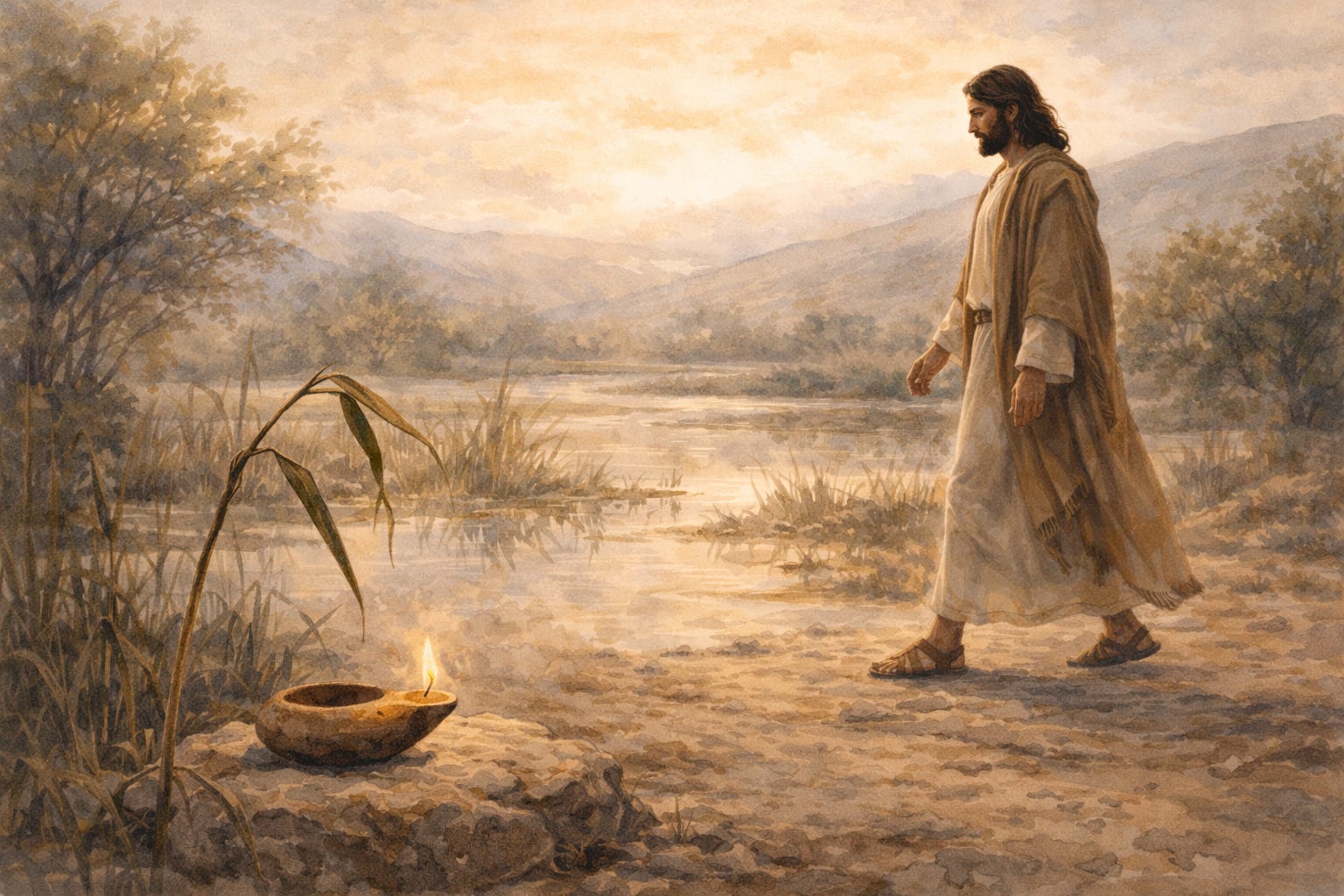
“Here is my servant, whom I uphold, my chosen one in whom I delight; I will put my Spirit on him, and he will bring justice to the nations. He will not shout or cry out, or raise his voice in the streets. A bruised reed he will not break, and a smoldering wick he will not snuff out. In faithfulness he will bring forth justice; he will not falter or be discouraged till he establishes justice on earth. In his teaching the islands will put their hope.” (Is 42: 1-4)
As mentioned in the earlier meditations, what makes the suffering of Christ more poignant is the incomprehension of the disciples. In spite of him reminding them again and again of how he was going to fulfil his ministry in the world, of the inevitability of his passion and death on the cross, the disciples failed to comprehend him.
In Mark 10: 32-40, we read that, oblivious to what Jesus had spoken to them, they were still arguing among themselves as to who among them was the greatest, as to who would sit next to Jesus in his glory. This is true even today. We are too pre-occupied with our earthly notions of power and privilege that we do not care to understand the true nature of Jesus’ ministry, how he brought salvation for us.
Jesus repeatedly tried to describe his ministry as that of the suffering servant. The above mentioned passage from the Book of Isaiah is one such instance where the nature and role of the suffering servant is elucidated.
The suffering servant is a King; he is the anointed one. He is the chosen one, in whom God delights. But the problem is that he is not like the kings and emperors of this world. It is in illustrating this difference that Jesus, as the suffering servant, becomes meaningful to us. We are called to follow the model of the suffering servant.
First, the task of the suffering servant of Yahweh is to bring forth justice to nations or establish justice on the earth. To bring forth justice means to execute God’s will. All our relationships will become just only when they are organised according to God’s will. It is common practice for all of us to talk of God’s will when things go wrong and not according to the way we have planned. We bring in God as a proposition to bridge or fill the gap in our understanding. What we have is a “God of the gaps”.
But here God’s servant is committed to organising the totality of his life and relationships, according to the will of God. It is about this justice and righteousness of God that we read in the Book of Isaiah. Do we have the commitment to work towards organising all aspects of our life according to the will of God?
He will not grow faint or be crushed until he has established justice on the earth. It is natural that most of us will grow faint and be crushed in this world, where much happens against the will of God.
Wars, ethnic and sectarian strife; the evil ones prosper while the poor and the down-trodden are crushed; the politician-criminal nexus rules the country and the mighty decide what is right in the world. In such circumstances, it is possible to get discouraged, and grow faint or crushed. But the suffering servant will not fail, but will persevere and strive tirelessly for the establishment of God’s will.
Second, he will not cry or lift up his voice, or make it heard in the streets. This is what the king and his army are normally expected to do, particularly when they return from war with victory. They show off their power and try to instil fear, shock and awe, among the people with their loud shouts, war cries and the trampling of their feet. But the servant of Yahweh will not show such expressions of brute force or revelry. He will be gentle.
He is characterised not by love of power but by the power of love: “For all the boots of the tramping warriors and all the garments rolled in blood shall be burned as fuel for fire.” (Is. 11: 5) He will be called the Prince of Peace. Our God is not a God of war.
Jesus as the suffering servant rules the world from the Cross. It is in this contrast that we can really understand the power of Christianity. The love of power versus the power of love: that is what we find on the Cross and passion of Jesus Christ.
Third, “a bruised reed he will not break, and a dimly burning wick he will not quench”. Reed is a weak plant that grows in marshy areas. What would happen to it if it was also bruised? Let us think of the many people in our society who are already vulnerable, weak and powerless: children, women, poor, elderly, sick and other socially and economically disadvantaged groups. What if they were to undergo further social and economic hardships, forced to live in unhealthy conditions, submitted to the violence of the powerful, without provisions for health care and other social securities?
Those constantly on the verge of being displaced, those subjected to live as refugees and strangers in their own lands, those subjected to the everyday violence of the state: they are all the bruised reeds in our society. The Servant of Yahweh will not break them. He will not give up on them. They are also the dimly burning wicks, whose oil is fast depleting and on the verge of being snuffed out.
The usual response of a market driven society is that as these bruised reeds and smouldering wicks have outlived their usefulness, let them have a natural death. We will allow them to die.
We consider as valuable only those that are useful, ‘productive’ or have some utility value. A dying old man or a woman who is shut in and forlorn, a battered woman who has nowhere to go for protection, a child who is denied the privilege of good education and other pleasures of life, the poor who cannot afford any costly medical treatment: it is easy and convenient to give up on them. But the God, who comes to us in Jesus Christ as the suffering servant, will not give up on them, and he will not give up on us.
Even when we go astray and bruise ourselves and waste all our resources and become like a dimly burning wick, he will not give up on us. Don’t we give up on our children, when they don’t live up to our expectations? Don’t we give up on our spouses, our dear ones, our friends and our neighbours? But God will not give up on us.
That is what we learn from the Cross of Christ. He will not break a bruised reed, and put out a dimly burning wick. Do we have this patience and commitment to sustain, encourage and preserve that which, from all worldly standards, is of no use or value?
As a community that follows Jesus Christ we are called to emulate his model of the suffering servant. But, the questions before us are how committed are we towards establishing God’s rule over all aspects of our life? How committed are we to protect, sustain and enhance the bruised reeds and the dimly burning wicks in our society?
The servant accomplishes his mission modestly and quietly, not by whipping people into conformity but by transforming them inwardly. The servant accomplishes his task not by force, but by his love. It is this king, who participates and remains in solidarity with those who are pushed to the margins of the society: the suffering servant: that we look forward to in realising the divine rule.