
The fifth Sunday in Lent is known as the Passion Sunday. The passion of Christ cannot be confined to the week preceding resurrection. The shadow of the cross and passion has been there all through the earthly ministry and life of Christ. Before we come to the crucifixion of Christ, church fathers might have thought it appropriate to meditate on what had led to the crucifixion of Christ.
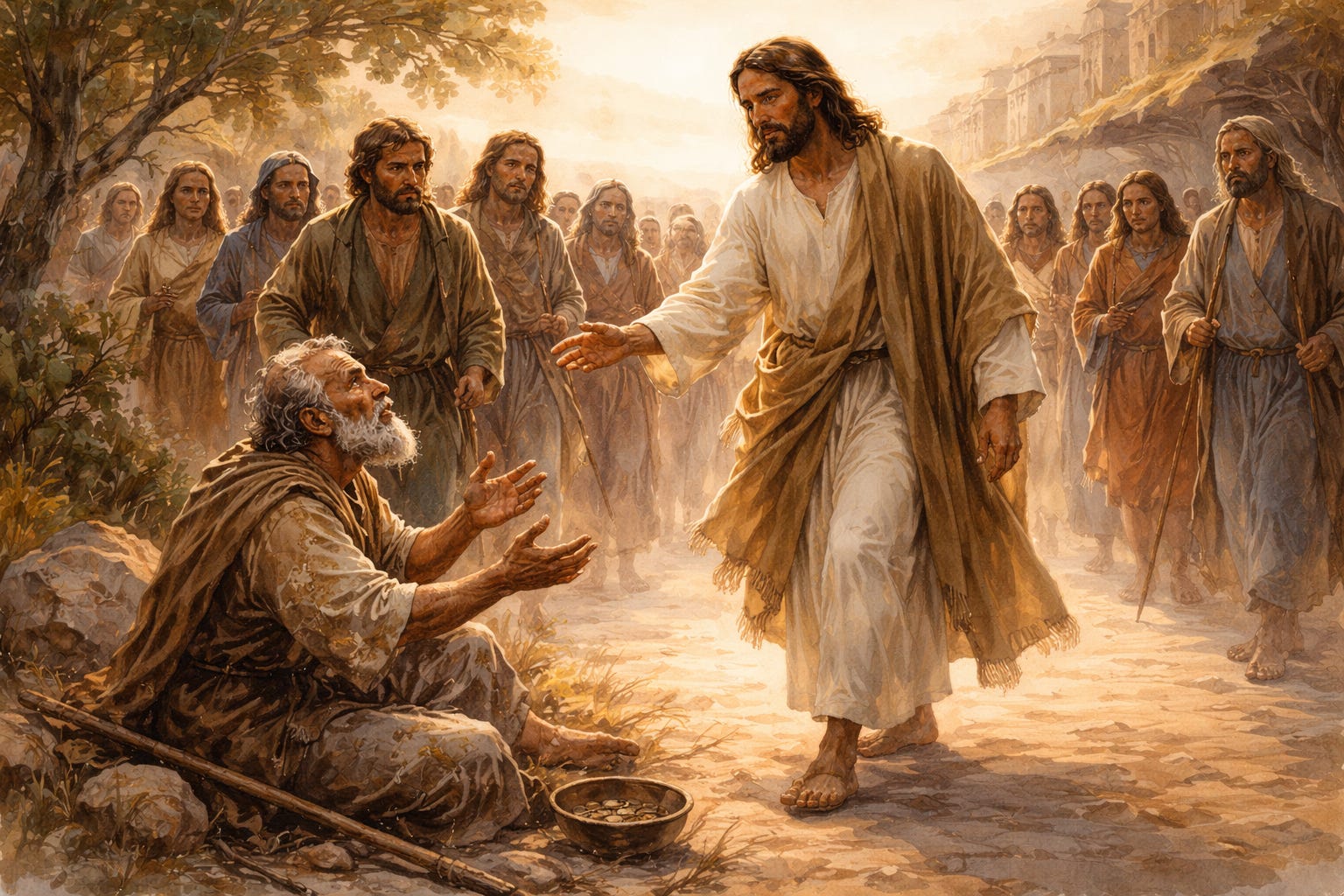
The blind man receiving sight, recorded in Luke 18: 35-43, has its parallel narrative in Mark 10: 46-52. Mark names the blind man Bartimaeus, meaning son of Timaeus. Timaeus means “foul, defiled, polluted, or unclean.” The blind man is treated virtually as an offspring of defilement and dishonour.
The story of Bartimaeus was narrated to highlight how he was transformed from being an offspring of defilement to being a claimant to the inheritance of the children of God, how he received sight and followed Jesus on his last journey to Jerusalem and Calvary.
Bartimaeus is presented in contrast to the disciples, James and John, who failed to understand the mission of Christ and hence, failed to follow Jesus all the way to Jerusalem and the cross. They were too caught up with the question of who would get the most respectable position in the Kingdom of God.
The key to understanding the story of giving sight to the blind man can be found in the question that Jesus had put forth to James and John, the sons of Zebedee, and to Bartimaeus, and the divergent answers that it elicited.
Jesus asked both of them the same question: “What do you want me to do for you?” James and John answered, “Let one of us sit at your right and the other at your left in your glory.” While Bartimaeus’ answer was, “Rabbi, I want to see.”
The story of the blind man is told as an epitome of discipleship; what it means to follow Jesus. What made the suffering of Jesus so unbearable was the incomprehension by those who were intimately associated with him, his disciples, of the mission and ministry of Jesus.
“He appointed the twelve that they might be with him and that he might send them out to preach and to have authority to drive out demons.” (Mk 3:14-15) And Jesus told them of what was awaiting him in Jerusalem: “the Son of Man must suffer many things and be rejected by the elders, the chief priests and the teachers of the law, and that he must be killed and after three days rise again.” (Mk 8: 31)
Jesus reiterated this to the disciples three times. Jesus further emphasised what it meant to be a disciple of Christ: “Then he called the crowd to him along with his disciples and said: ‘Whoever wants to be my disciple must deny themselves and take up their cross and follow me. For whoever wants to save their life will lose it, but whoever loses their life for me and for the gospel will save it’” (Mk. 8: 34-35).
Despite this clarification by Jesus, the disciples were all along arguing among themselves who would be the greatest in the kingdom of God. Is this not the real state of affairs in the Church and all of us who claim to be his followers?
The other disciples learned about the request of James and John. We read in Mark 10: 41 that the other disciples became angry with James and John. So Jesus had to call them apart and once again reiterate his mission and their role in it: “You know that those who are regarded as rulers of the Gentiles lord it over them, and their high officials exercise authority over them. Not so with you. Instead, whoever wants to become great among you must be your servant, and whoever wants to be first must be slave of all. For even the Son of Man did not come to be served, but to serve, and to give his life as a ransom for many.” (Mk 10: 42-45)
Our consistent refusal to understand the mission of Christ and participate in it, to follow the way of the cross, pains the heart of Christ more than anything else; this makes his suffering more poignant. Over against this, we find the story of the blind man, Bartimaeus: the epitome of Christian discipleship.
First and foremost, discipleship requires an awareness of one’s blindness, inability to understand one’s true state of affairs or to judge the reality around oneself. Bartimaeus had a very clear and ready reply to Jesus’ question, “What do you want me to do for you?” He did not ask for money to support himself; he did not ask for alms as any beggar would do. He replied, “Rabbi, I want to see.”
In the Gospel of John, concluding the story associated with the healing of a blind man, Jesus said to the Pharisees, “If you were blind, you would not be guilty of sin; but now that you claim you can see, your guilt remains.”
We who claim to be Christians and are very conscientious in following outward rituals of religion, fail to realise that we are blind to Christ and His mission in the world like Christ’s disciples themselves. It is important that we turn around, recognise our true state of affairs, and cry aloud for Christ’s intervention in our life.
Second, Bartimaeus acknowledged Jesus as the son of David, the anointed one, the Saviour. Hence he persistently cried out, saying, “Son of David, have mercy on me”; despite the best efforts of the crowd to silence him, he shouted all the more. And such was his faith. “Have mercy on me” is a cry of utter helplessness and desolateness and a cry for redemptive action.
This is the same cry that emanated from the tax collector and one of the criminals who was crucified with Jesus. This cry had found a central place in the worship of the Eastern churches: “Kyrie eleison”. We all need a clear sight and a new sight; we are blinded by the princes of this world that we have become unable to see the beauty of the cross.
Third, Bartimaeus was willing to risk the dangers ahead and also his possessions that provided him with security and certainty. We read in Mark 10: 50 that he threw his cloak aside, he jumped to his feet and came to Jesus. A beggar’s cloak is his sole possession. It contained whatever valuables he wanted to store for himself; moreover, it provided protection from the hostile climate.
To throw away the cloak meant to risk all; and then, for a blind man to jump to his feet and rush to Jesus meant to totally risk himself to the grave dangers that are on his way. Nothing in his life was as important as meeting Jesus and being able to see.
As Paul writes in Philippians, “But whatever were gains to me I now consider loss for the sake of Christ. What is more, I consider everything a loss because of the surpassing worth of knowing Christ Jesus my Lord, for whose sake I have lost all things. I consider them garbage, that I may gain Christ.” (3:7-8).
Bartimaeus was prepared to sacrifice all for the sake of knowing Christ, and knowing himself through the eyes of Jesus and thus, find the fullness of life.
Finally, Mark Ch. 10 records Jesus’ words: “Go, your faith has healed you.” Immediately he received his sight and followed Jesus along the road. Bartimaeus received not only his sight, but he followed Jesus along the road to Jerusalem and the cross. He became a disciple of Jesus.
If he had missed that opportunity, he would have missed it for life. That was Jesus’ last journey. It was a choice between life and death for Bartimaeus. It is the same for us too. We must cry aloud as Bartimaeus did, “Jesus, Son of David, have mercy on me!” and plead, “Rabbi, I want to see.” Nothing is more important in life than having our sight restored and following Jesus on the long road to Calvary.