
“For even the Son of Man did not come to be served, but to serve, and to give his life as a ransom for many.” (Mk. 10:45)
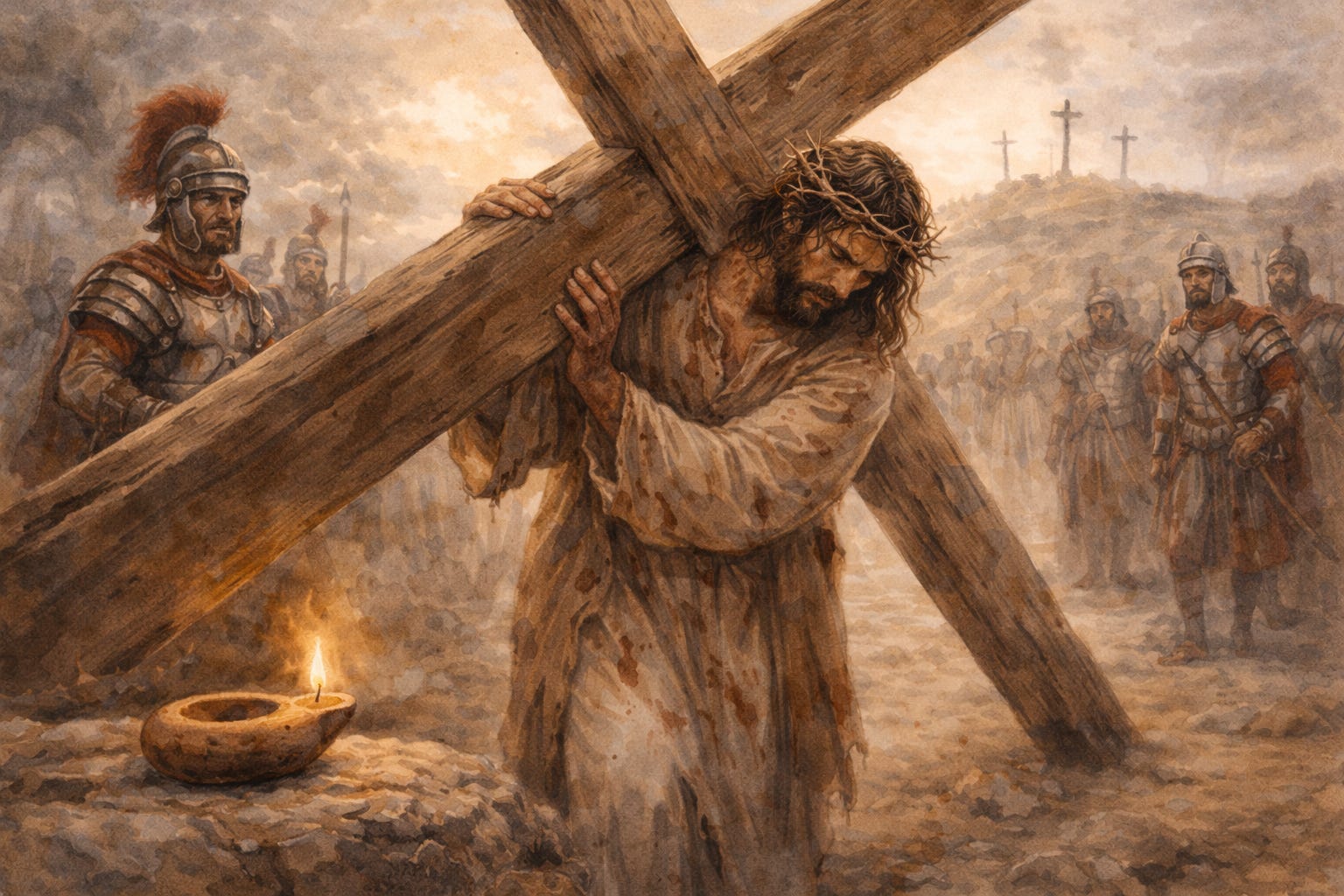
What makes the suffering of Jesus very poignant is that his own disciples were blind to the reality of the Cross. In Mark’s gospel we find three instances of Jesus announcing the suffering he would encounter in Jerusalem at the hands of the religious leaders; we also find three instances of the disciples never really grasping the true meaning of it. The disciples never understood, nor did they care to understand the mission of Christ.
It was only after Jesus’ third announcement of passion (Mk 10: 32-34) that we find James and John, coming to him with the request, “Let one of us sit at your right and the other at your left in your glory.” Even then, they were quarrelling among themselves for positions of power. What they wanted was to persuade Jesus to exercise his authority in such a way that they would have all that they want: power, prestige, wealth and whatnot. They never could or wanted to understand the true meaning of the Cross and passion of Jesus Christ.
The content and style of Jesus’ mission in the world is brought into sharp focus on the Cross of Christ. It is very clearly and sharply explicated in a very short verse, in Mark 10: 45, “For even the Son of Man did not come to be served, but to serve, and to give his life as a ransom for many.”
Jesus becomes a ransom for us. Ransom is the price one would pay for the release of a person or a piece of property. Jesus wants to deliver us from sin and its consequences, and he achieves this by taking responsibility for our sins, by paying the price, by giving his own life as a ransom. God sent his only begotten son to achieve what the law could not.
The first attempt to deal with sin was to provide us with laws or commandments. But, the law made us only aware of our sinfulness: Paul writes in Romans Ch. 7, “Nevertheless, I would not have known what sin was had it not been for the law. For I would not have known what coveting really was, if the law had not said, ‘You shall not covet.’” Referring to the commandments of Moses, Paul makes it clear that the commandments of Moses could only make sin utterly sinful; in other words, the law can only make us feel guilty.
The response to a sense of guilt takes two forms. One is to strive to strictly adhere to the law, especially the letter of the law; engage in restrictive behaviours that would avoid any possibility to sin, thereby putting our life in a straitjacket. This is called legalism; submitting to strict adherence to the letter of the law to such an extent that we are unable to fulfil its spirit.
The Pharisees represent this legalistic response to the sense of guilt. Jesus rebukes the Pharisees, “Woe to you, teachers of the law and Pharisees, you hypocrites! You give a tenth of your spices: mint, dill and cumin. But you have neglected the more important matters of the law: justice, mercy and faithfulness.”
The second response is that of reparation or compensation for one’s sins, paying the cost of our sins through compensatory responses, so that our consciences would be cleansed of our sense of guilt. Obsessive-compulsive behaviour is an extreme form of this compensatory behaviour. It comes out of our terrible sense of insecurity and guilt. The whole book of Leviticus, from the beginning to the end, lays out the costs involved in compensating sin: the blood of bulls, birds, lambs and so on.
The blood of goats and bulls and the ashes of a heifer were to be sprinkled on those who were guilty so that their consciences would be cleansed. In the book of Hebrews, the writer refers to these ceremonial acts or rituals as ‘dead works’.
What we see here is the development of a religious system that ties us down to legalism and ritualism or ‘dead works’ that are meant to purge our consciences of guilt, rather than enabling us to serve the living God. Religion, thus, enslaves us to the cycle of law, guilt and dead works.
In effect, this vicious cycle of religion survives on law or commandments, rituals and sacrifices, hierarchy of priesthood to perform those sacrifices, and man-made altars and places of worship. This is described in the scriptures as the old covenant or the first covenant. It lends itself to becoming exploitative, burdensome and repetitive.
Religion thrives on the guilt of people and the fear of retribution, that God would punish them for their sins and hence, they would have to appease God to receive His blessings.
In the place of such religion, Jesus establishes a new covenant, a new spirituality of relying on and having confidence in the unconditional and abiding love of God in Jesus Christ, wherein, by opening ourselves to God’s love, we become channels of God’s love in the world to abound in good works. The law is replaced by love and grace.
It is this love of God that we find in Jesus Christ. Jesus has paid with his life the ransom to liberate us who had been sold into slavery. It is not that the cost and consequence of sin is any less serious; it is that Christ has taken the responsibility for our sins and their consequences. “He took up our pain and bore our sufferings, he was pierced for our transgressions, he was crushed for our iniquities; the punishment that brought us peace was on him, and by his wounds we are healed.” (Isaiah 53:4-5) About this sacrifice of Jesus, we read in 1 Peter Ch.1: 18-19: “For you know that it was not with perishable things such as silver or gold that you were redeemed from the empty way of life handed down to you from your ancestors, but with the precious blood of Christ, a lamb without blemish or defect.”
Jesus frees us from law and death, to love and serve God and our fellow human beings. About this new covenant, we read in Hebrews Ch. 9: 12: “He did not enter by means of the blood of goats and calves; but he entered the Most Holy Place once for all by his own blood, thus obtaining eternal redemption.” Thus Jesus liberates us from bondage to dead works to a life that is free to love and serve.
The Cross of Jesus Christ has done away with the old covenant and the associated religiosity and its structures and practices and has established in its place a new covenant and a new spirituality of loving and serving the world and fellow human beings. He redeems us from our dead works to serving and loving our fellow human beings and the creation.
In this new spirituality, there is no priesthood, no sacrifices, no altar, and no holy temple. What is significant is faith expressing itself through love. About this new spirituality, Paul writes to the Galatians, “For in Christ Jesus neither circumcision nor uncircumcision has any value. The only thing that counts is faith expressing itself through love.” (Gal. 5:6)
The key element of this spirituality is love translated into responsible action and service. Jesus is the model for this new spirituality. Jesus took responsibility for our sins; he willingly took up on himself the consequences of our sin. He did not save us by his power; he strove to persuade us by his unconditional love. “Jesus came not to be ministered unto, but to minister and give his life as a ransom for many” (45). The passion and the Cross of Christ invite us to this spirituality and self-giving love as the key towards liberating this world from its bondage to sin.
Our calling as Christians is to continue this ministry of being responsible for this world and our fellow human beings. Instead of striving to become such a community, we are fighting for power and positions of authority.
It is not by miracles and supernatural exercise of power that he heals us, but by his self-giving and transforming love, his ‘cruciform’ existence.
Are we ready to opt for this spirituality? Are we ready to take on the obligations implied in this way of following Christ? Are we ready to become a servant community in this world and be a ransom for our brothers and sisters?
Are we willing to lead a ‘cruciform’ existence in this world: a life of love, solidarity, responsibility, humility, and a sacrificial life of service to our fellow human beings and the world around us?
In this we shall be known as Christ’s followers. Only the Cross of Christ and our ‘cruciform’ existence in the world can bring wholeness and peace, and salvation to this world. Will we submit ourselves to Christ for this cruciform existence? That is the challenge that the Passion Sunday and the Cross brings to us.