
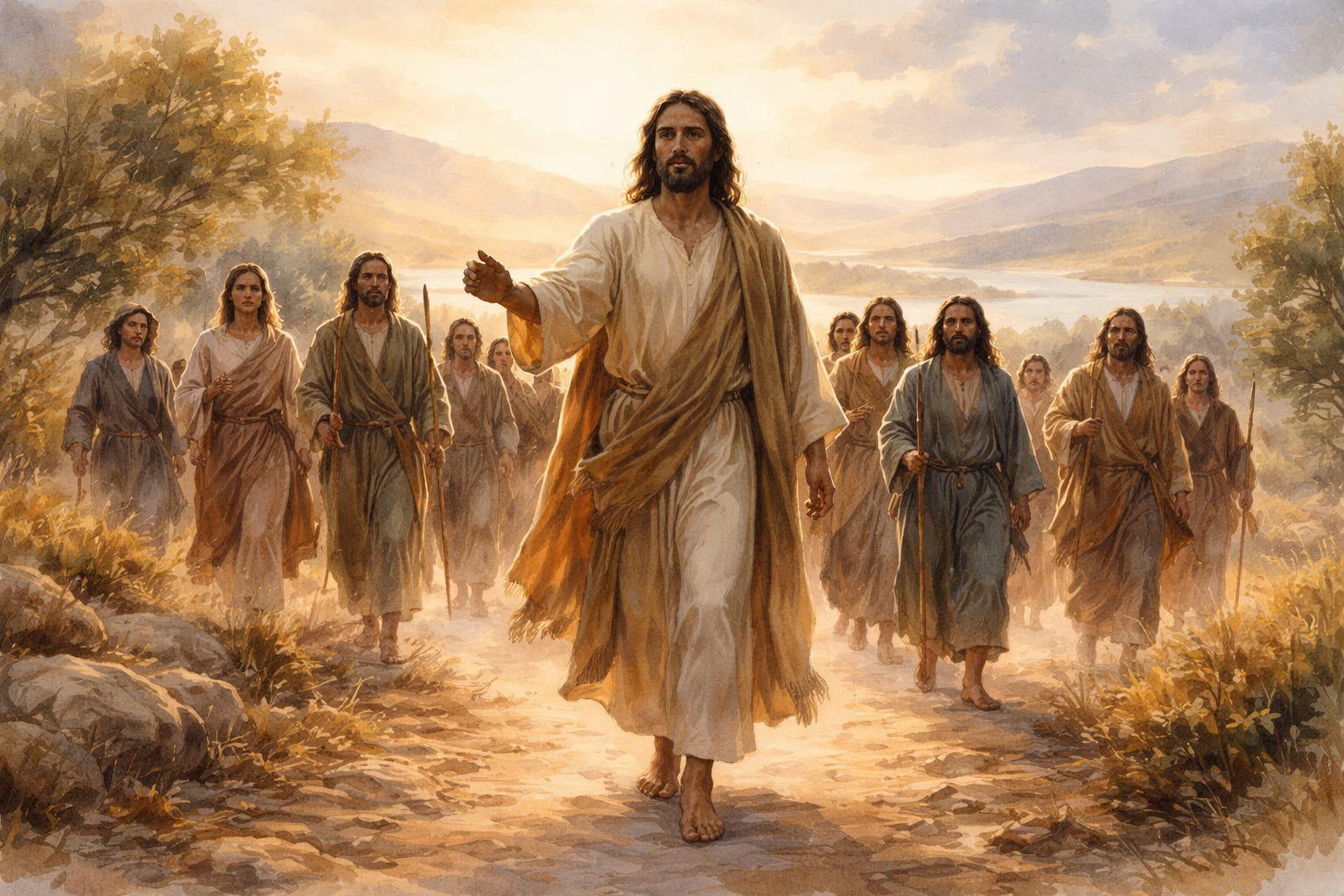
Large crowds were travelling with Jesus, and turning to them he said: “If anyone comes to me and does not hate father and mother, wife and children, brothers and sisters – yes, even their own life – such a person cannot be my disciple. And whoever does not carry their cross and follow me cannot be my disciple (Luke 14: 25-27).
Jesus was on his way to Jerusalem. He knew what awaited him: hostility and violence, suffering and death. However, those around him were oblivious to his fate. There was an enthusiastic crowd that followed Jesus, but for all the wrong reasons. They never comprehended his mission. Jesus knew that the enthusiasm of the crowd could not be an indicator of the success of his ministry. In fact, for him, it was a problem to be dealt with. And so he turns to them and asks them to take another look at the implications of following him.
Are we one among this crowd or different? Why do we follow him? Have we taken time to count the cost of following him?
Many people believed in Jesus because they saw the miracles he did. But Jesus did not trust them (John 2: 23). I believe that there is much similarity between us, the privileged, churchgoing Christians of Kerala, and the crowd that followed Jesus. The crucial aspect of that similarity is that they and we value family ties and commitments above all else. Parents are anxious and would do anything to make the life of their children secure.
We do not want our children to be distracted, and not even be bothered by the concerns of society or even that of God’s kingdom that would ultimately demand their commitment. As parents, we do not want our children to have any vision of life that transcends material prosperity and well-being. We want them to be outwardly devout and keep away from vices to the extent that they would not be a hindrance to pursuing their worldly ends of good and secure jobs, high salaries and material comforts. We foolishly believe that we can make our life secure through our children.
Jesus turns to them and proclaims that a price, a heavy price, is to be paid by those who follow him. “If anyone comes to me without hating his father and mother, wife and children, brothers and sisters, and even his own life, he cannot be my disciple” (Lk 14: 26).
The word ‘hate’ may appear too strong a word to be used; but, considering the nature and mental set of the crowd it was necessary to resort to the use of such a word to emphasize the fact that no earthly tie, however close, must take precedence over our allegiance to and obedience of Jesus.
Jesus says to the crowds travelling with him: Unless you place me as the first priority, over every other priority in your life, you can’t be my disciples.
His words speak to you and me. We cannot avoid or explain away their impact and force.
Jesus makes use of a similar hyperbole, an overstatement in order to make a point with maximum impact, when he is confronted by the rich young ruler: he tells him “You still lack one thing. Sell everything you have and give to the poor, and you will have treasure in heaven. Then come, follow me.” (Lk. 18: 22) We read about the response of this young man, “When he heard this, he became very sad, because he was very wealthy.”
Jesus makes it clear to the crowd that followed him and to us as well, that it is not enough to be a Christian, but rather, what he expects us to do is to leave all and follow him, to be a disciple. Jesus does not call us to belong to a religious community called Christianity and follow its prescriptions, but he calls us to be his disciples.
Christian is a nomenclature for a group of people who subscribe to certain doctrines and religious practices. And there is nothing distinctive or great about Christianity as a religion. In fact the term “disciples” occurs 269 times in the New Testament, while the term “Christian” occurs only three times.
In the Book of Acts we are told that “The disciples were first called Christians at Antioch” (Acts 11: 26). The disciples are Christians, but all Christians are not disciples of Jesus Christ.
Jesus makes clear the cost of discipleship: “If anyone comes to me and does not hate father and mother, wife and children, brothers and sisters – yes, even their own life – such a person cannot be my disciple. And whoever does not carry their cross and follow me cannot be my disciple.”
Jesus reiterates this to his followers on another occasion: “If anyone would come after me, let him deny himself and take up his cross daily and follow me.” (Lk 9: 23).
In the words of the famous theologian and martyr, Dietrich Bonhoeffer, “To deny oneself is to be aware only of Christ and no more of self, to see only Him who goes before and no more the road which is too hard for us… All that self-denial can say is: ‘He leads the way, keep close to Him.’” To deny oneself is to let Christ have complete sway over our life. This exclusive allegiance to Christ leads us to carry our own crosses.
We often use the word cross to refer to any painful experience that we may encounter such as death, calamities, sickness and other adversities and tragedies that are an essential part of our human existence. They are not the result of our choice; they happen to us. Carrying one’s cross refers to the suffering one has to encounter as part of his or her choice and decision in agreement with the will of God. It is the inevitable consequence of a life lived as Christ lived it in this world.
Cross awaits only a Christian who takes this world and history seriously. It is the decisions that one takes within it in accordance with the will of our Heavenly Father that brings him or her into conflict with the rulers of this world, whether it be that of religion or that of politics.
Cross is the price that Jesus paid for standing up to dehumanizing forces in this world; he exposed the hypocrisy of the religious leaders; he remained in solidarity with those who were excluded by the religious and respectable people of the Jewish society of his time. In all situations of life he acted with responsibility.
Cross is the price Jesus paid for taking responsibility for our sin and the world we have messed up through our sin. If we make choices and decisions like Christ in our life situations, if we act like Christ against the injustices that we find around us, and if we take responsibility as Christ for this world and our fellow human beings, we cannot escape our crosses.
Unfortunately, we have a Christianity that does not glory in the cross of Christ, but in a piety and morality that is more a part of middle class respectability than of following Jesus Christ. We do not have our crosses to bear because we cannot allow the world to hate us.
Jesus told his brothers who were encouraging him to show himself off and be famous, “The world cannot hate you, but it hates me because I testify that its works are evil” (Jn 7: 7).
The fact is that the world does not hate us. We do not testify to the world that its ways are evil. Rather, we are conforming to its evil ways, and making maximum benefit out of it. We have worked out a Christianity that is convenient for us. This sort of Christianity is on public display today and it is more a disgrace to Christ than witnessing God’s rule on this earth. However, we can be a remnant that takes our discipleship seriously and pays the price for it.