
“I, John, your brother and companion in the suffering and kingdom and patient endurance that are ours in Jesus” (Rev. 1: 9-20)
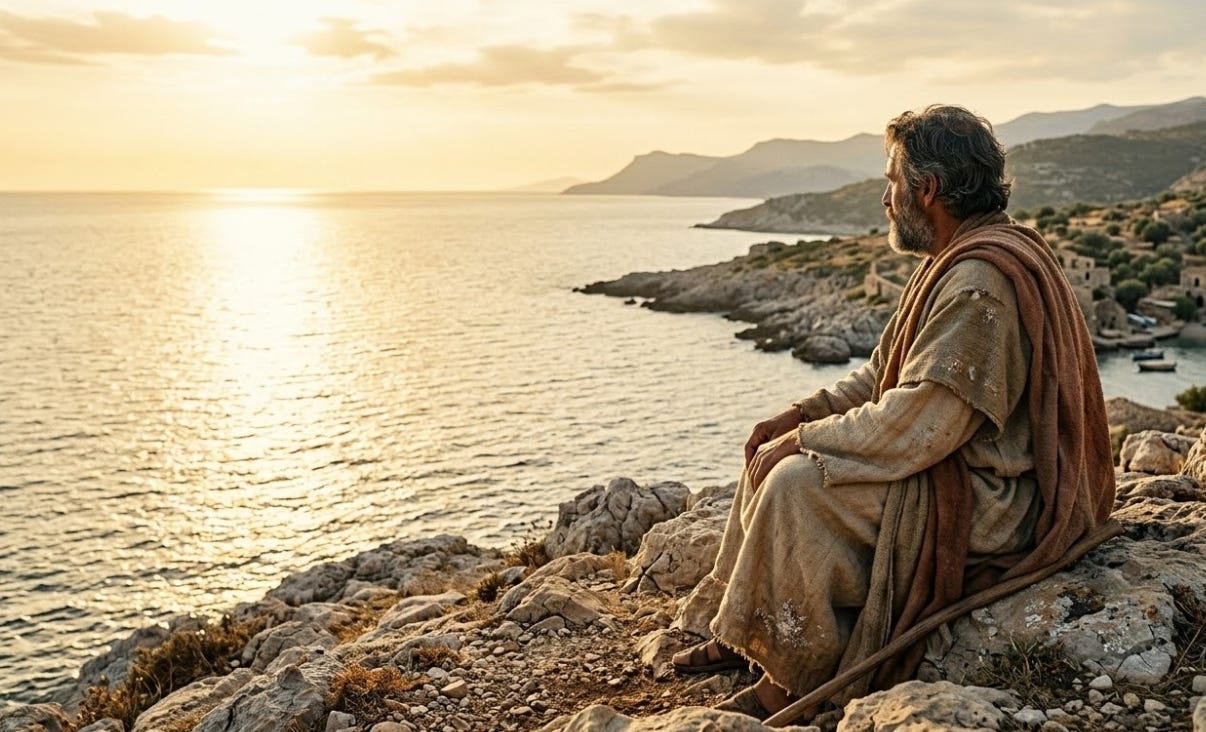
The Apostle John was exiled to the prison island of Patmos for preaching the Gospel. He was sent to a place where he had no one to preach to. There the Lord appeared to him in visions and commanded him to write them down in a book, which is today known as the Book of Revelation.
These visions occurred to John in the context of terrible persecution that the church was undergoing under the Roman Empire. These persecutions did not deter Christians from being faithful to Christ. Rather, they turned suffering into occasions to celebrate their loyalty and faithfulness to Christ.
They experienced the reality of Christ’s presence in their midst. They also saw him lifted up and seated on the throne as Lord, upholding the church in his hands. John “saw seven golden lampstands, and in the midst of the lampstands I (he) saw one like the Son of Man.” “In his right hand he held seven stars.”
Further on, John received an interpretation of the seven stars and the seven lampstands: “The seven stars are the angels of the seven churches, and the seven lampstands are the seven churches.” (Rev. 1:20)
The one like the son of man introduces himself: “I am the First and the Last. I am the Living One; I was dead, and now look, I am alive forever and ever! And I hold the keys of death and Hades” (Rev. 1: 17-18).
The risen Christ holds the keys of death and Hades; he is the one who is able to destroy death and liberate the dead from the place of their residence, from Hades. The early Christians believed that the Roman Empire could not do anything to them. Death did not frighten them; they knew that death could not imprison and hold them captives forever.
At the beginning, John introduces himself to the readers: “I, John, your brother and companion in the suffering and kingdom and patient endurance that are ours in Jesus” (Rev. 1:9). Here, John clarifies his self-understanding. In relation to fellow Christians, he understands himself as “brother and companion”.
Since he writes to seven churches, we can assume that John had seven churches under his episcopate or supervision and hence could be considered as having a leadership role in the church; he could be considered an episcopos. But John denies any power hierarchy within the church; he considers himself a “brother and companion” to them.
His right to speak to them derives not from any ecclesiastical appointment but from his experience of persecution like any of the Christians in Asia Minor. Throughout the book, you can find this notion of “brother and companion”.
The hierarchisation of power, centralisation of power, in a few people is a remnant of our feudal past and today, it is undermining the very witness of the church. The power hierarchy and the ritual power attributed to them have become more important in the life of the church than a lifestyle in keeping with the values of the Kingdom and our witness to it.
John reminds the churches in Asia Minor of the three attributes he shares with them in Jesus Christ: suffering (thlipsis), kingdom (basileia) and patient endurance (hupomone).
1. Suffering (thlipsis)
John shares in their suffering, their distress, persecution and repression. It is not the kind of suffering that is part of human existence, but one that is borne as part of one’s commitment to Christ and his Kingdom. Distress or suffering refers more to the oppression, marginalisation, and ongoing humiliation that believers had to endure in the Roman Empire.
Anyone who lives in total allegiance to Christ had to go through experiences of persecution and suffering. This is what Jesus had to communicate to his disciples towards the end of his life: “I have told you these things, so that in me you may have peace. In this world you will have trouble/tribulations. But take heart! I have overcome the world.” (Jn. 16:33)
“And all nations will hate you because you are my followers. But everyone who endures to the end will be saved.” (Matt. 10:22)
About the early Christian leadership in the church, we read in the Acts of the Apostles: “The apostles left the Sanhedrin, rejoicing because they had been counted worthy of suffering disgrace for the Name.” (5:41)
We also read: “For even his own brothers did not believe in him. Therefore Jesus told them …the world cannot hate you, but it hates me because I testify that its works are evil.” (Jn. 7: 5-7)
2. Kingdom (basileia)
In more positive terms, John shares in the Kingdom, “reign”, the rule of God (basileia) in Jesus Christ. This gives meaning to their suffering; their suffering is a means to enter into the glory of the Kingdom. Christians seek to build the reign of God on earth; and hence, they strive to build the church as a community that is an alternative to the empire.
While we have suffering in the world, we are also called to reign with Christ in God’s kingdom. We read in Ephesians 2: 5-6: “even when we were dead in trespasses, (He) made us alive together with Christ (by grace you have been saved), and raised us up together, and made us sit together in the heavenly places in Christ Jesus.”
We are called to replicate God’s model of government, an alternative vision of organising the life of this world as God wants it to be, in the life of the church and thus make it the ‘first fruit’ of God’s kingdom in the world. It is this commitment to the alternative rule (kingdom) in Christ that brings us into conflict with the powers and rulers of this world and thus causes suffering and persecution.
3. Patient Endurance (hupomone)
This sort of commitment requires us to endure, struggle, and resist (hupomone). John understands himself as called to share in their patient endurance that is theirs in Christ. In Greek, the meaning of the word hupomone does not simply mean to passively submit to the tide of events with folded hands and bowed heads. It means to be endowed with a spirit of courage and resistance. The book of Revelation is replete with this “call for endurance and faith of the saints.”
Christian existence is in thlipsis; they live in the midst of persecution; they are also looking towards basileia, the kingdom. It is a movement from thlipsis to basileia, from affliction to glory, via hupomone: gallant and courageous endurance and resistance.
In Hebrews 12:4, we read: “In your struggle against sin, you have not yet resisted to the point of shedding your blood.” Steadfast endurance is a call to resist the world as it is organised today and stand up for the values of the Kingdom and embrace martyrdom whenever and wherever that is required.
Revelation makes this clear with repeated references to endurance: “If anyone is to go into captivity, into captivity he will go. If anyone is to be killed with the sword, with the sword he will be killed. This calls for patient endurance and faithfulness on the part of the saints.” (Rev. 13:10)
We, as Christians, are called to resist by holding on to an alternative vision and alternative lifestyle.
Today, we as a church live very much in line with the world; we do not testify to the world that its works are evil and hence, we do not have any suffering. We live completely forgetting the fact that our calling is to live in the world as citizens of heaven and ambassadors of Christ.
Though we pray many times ‘thy kingdom come’, we do not work for it or even uphold it as a model to live by. Resistance has given way to active indulgence in the ways and priorities of this world.
This world has become a cosy and comfortable place to live in, except when we are confronted with sickness, death and other uncertainties of life. It is this situation that calls for reflection and rethinking of our Christian discipleship.