
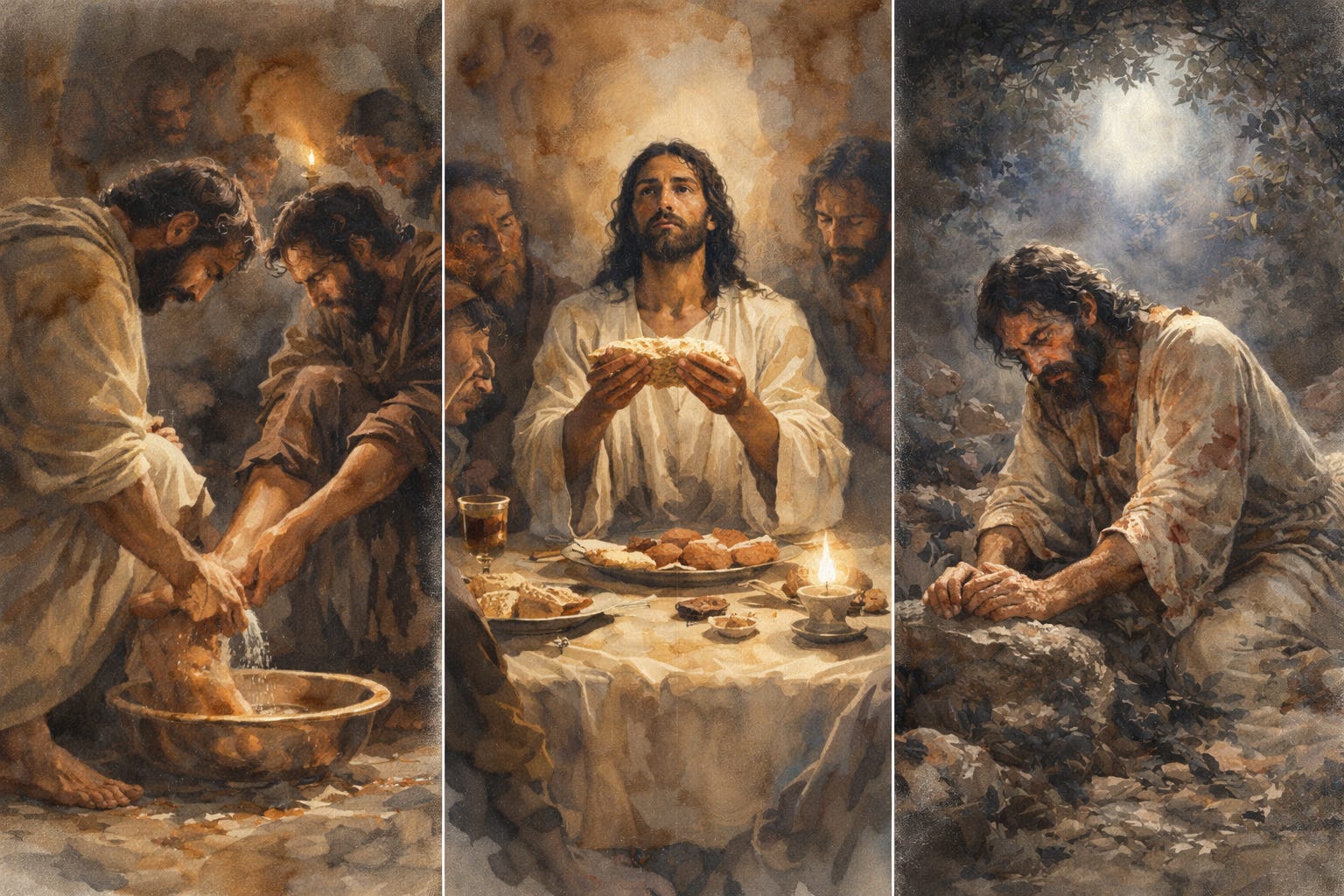
On Maundy Thursday, we commemorate three events that are a precursor to the arrest, persecution, crucifixion, death and resurrection of Jesus Christ, events that are supremely significant and pregnant with meaning for the community of the faithful and for the whole of humankind. Maundy comes from the Latin word mandātum, which means “mandate or command.” In the Gospel of John, Jesus says: “A new commandment I give you, that you love one another; even as I have loved you, that you also love one another.” (13: 34)
The first event, therefore, that we celebrate is the new commandment that Christ gave to his disciples and how that was demonstrated by washing the feet of his disciples, taking on the role of a servant. In a Jewish feast, as a courtesy, a servant is expected to wash the feet of the guests. Jesus came to this world to demonstrate love of God in action.
The intricacies of God’s love, its depth and form cannot be described in words but only demonstrated in action and that too, through imperfect human means. Such a metaphor is that of a servant; it is being for others, their comforts and their wellbeing. “If I then, your Lord and Teacher, have washed your feet, you also ought to wash one another’s feet (13: 14). This is the kind of respect and concern that is required of us as human beings. In the letter to Philippians, apostle Paul articulates the love manifested in Jesus Christ (Phil 2: 6-8).
In your relationships with one another, have the same mind set as Christ Jesus:
Who, being in very nature God, did not consider equality with God something to be used to his own advantage; rather, he made himself nothing by taking the very nature of a servant, being made in human likeness. And being found in appearance as a man, he humbled himself by becoming obedient to death, even death on a cross!
Addressing the disciples who consistently failed to understand his mission and quarrelled among themselves as to who is the greatest among them, Jesus said: “You know that those who are regarded as rulers of the Gentiles lord it over them, and their high officials exercise authority over them. Not so with you. Instead, whoever wants to become great among you must be your servant, and whoever wants to be first must be slave of all. For even the Son of Man did not come to be served, but to serve, and to give his life as a ransom for many.” (Mk 10: 42-45)
The symbolic gesture of washing the feet of few members in the congregation on a Maundy Thursday should not make us complacent to the grim reality where preoccupied with its own development and institutional maintenance, the church has reduced itself to a body that only strives to accrue power and wealth, breeding dissension and discord.
Here it is worth reminding ourselves of what Dietrich Bonhoeffer wrote: “The Church is the Church only when it exists for others... not dominating, but helping and serving. It must tell men of every calling what it means to live for Christ, to exist for others.” I would like to refer to this being-for-others as Cruciform existence. The church is called to be a cruciform presence in the communities that we serve.
This way of being in the world has become strange to the mainline churches; they are in an effort to maintain the top-down ecclesiastical hierarchy without being able to share in the agony of Christ for the world. Bonhoeffer advocated “religionless Christianity.” It is the love of Christ, manifested in concrete terms in our communities, that can make a difference to the world. They must be prepared to dissolve and be lost as salt and leaven and thus remain obscure and self-effacing.
On Maundy Thursday, we also commemorate the Passover meal that Jesus had with his disciples and instituting it in perpetual remembrance of Christ’s precious death until his coming again. In continuity with the meaning attributed to the Passover meal, this meal is shared in thanksgiving for the redemption wrought for us in Jesus Christ. Hence, it is often referred to as the Holy Eucharist, a sacrament of thanksgiving.
It is primarily a meal, a shared meal, in which Jesus Christ himself is the chief celebrant and the host. He gives himself to us as a living sacrifice; he takes responsibility for our sins that have marred God’s beautiful creation. God in Jesus Christ takes on the suffering of his creation. Hence, the Holy Eucharist is known in Eastern Christianity as Holy Qurbana; Qorban is a Hebrew term used for the offerings brought to the temple.
Those who partake of the body and blood of Christ are united in the sacrifice of Jesus Christ and are sent forth into the world with the same mission and predicament as that of Christ. Hence, the churches in the Catholic communion call Holy Eucharist, Holy Mass. The word Mass comes from the Latin word, Missa; the word Missa comes from the word Misso, the root of what is referred to as ‘Mission’ in English. It is associated with the words of commissioning or sending forth: ‘you the Church is sent’.
The Mass hence is to be lived; we live the Mass in so far as we live lives of sacrifice. However, it is not just an individual affair but a corporate sharing of Christ’s sacrifice and suffering for the world. The community of believers become one with Christ in his sacrifice of himself for the redemption of the world. Hence, the Holy Eucharist is also known as the Holy Communion. It is no longer that we live, but Christ lives in us. We are united in the self-sacrifice of Christ for the world; we become the body of Christ.
The Holy Eucharist is often wrapped in an aura of mystery and hence to be taken without asking further questions, a mechanical act that is efficacious and beneficial. The fact that the Holy Eucharist is an act of self-offering is a corrective to this understanding.
The Gospel of John doesn’t describe the words of the institution of the Holy Eucharist. Instead, there is the feeding of the five thousand, where the multitude was fed with the “five small barley loaves and two small fish” that was given to Jesus by a slave/boy (Jn. 6: 9). “Jesus then took the loaves, gave thanks, and distributed to those who were seated as much as they wanted (Jn: 11). It is our offering of ourselves that Jesus blesses, breaks and distributes to all and sundry in great measure.
Without this human agency, God is helpless in channelling his blessings to a world in need. This is poignantly manifested in the liturgy of the Church of South India where in the elements (the bread and wine), the fruits of human labour, are brought to the altar along with the offertory alluding to the act of the slave/boy in the narrative of feeding of the five thousand. This is again acted out in the parable of the institution of the Holy Eucharist.
M. M. Thomas refers to the revolutionary nature of the Holy Eucharist when he defines the Holy Eucharist as constituting spiritual communion, social community and economic communism. This is subtly and yet sharply articulated in Acts 2: 42-47; 4: 32-35. The hallmark of a caste ridden society is non-commensality, refusing to have meals together with others outside of one’s caste group. The Holy Eucharist calls for creating a society that is inclusive of all, particularly those who are kept outside of one’s definition of “neighbour” (in Jewish society).
The Holy Eucharist challenges us to work towards a social, economic and political order that is caring towards the most in need in our society. St. Paul articulates this when he elucidates the meaning of Eucharist in 1 Cor. 11: “It is not the Lord’s Supper you eat. For when you are eating, some of you go ahead with your own private suppers. As a result, one person remains hungry and another gets drunk… So then, my brothers and sisters, when you come together to eat, wait for one another.”
The meaning of “waiting for one another” must be understood in the context of a society where one person “remains hungry and another gets drunk”. Ensuring meals for the other is uplifted as an essential message of partaking in the body and blood of Christ.
Lastly, the Holy Eucharist is a meal that is eaten as a ‘foretaste’ of God’s Kingdom that has been inaugurated by Jesus Christ by His death, resurrection and ascension. The foretaste makes us restless to make God’s rule a reality in any given social order and earnestly seeking and working for the penultimate realisation of God’s Kingdom, wherever we are placed. It is a feast of the Kingdom, where Jesus is the chief celebrant, and we are all disciples who serve the meal to a world that is ‘hungry’.
The third event that we remember on Maundy Thursday is Jesus’s mental agony and final decision to take up his cross in utter isolation, deprived of the solidarity of his close companions (Mk 14: 32-42). This is the culmination of several instances where his disciples failed to comprehend his ministry and remained indifferent to it; where Jesus reiterates it in no uncertain terms of the agony he has taken on for the world, as an authentic human being.
Jesus continues to trust the agency of this sleeping community, the church, to deliver God’s redemption to a world in need of God’s love through its cruciform existence.
The Son takes up himself the responsibility to reclaim the world for his father and establish His rule over all the earth. But, it is only through his suffering and death on the cross. Jesus leaves us with the exhortation, “Rise! Let us go! Here comes my betrayer!” It is a clarion call to the church, sleeping as it may be, for repentance, discipleship, preparedness for combat, readiness to suffer and face martyrdom with the sure hope in the victory of the cross.
Thus, Maundy Thursday remains a precursor to the final moments of Christ’s journey to the cross reminding the church of the nature of its being and task in the world and how it is to be fulfilled.