
Sin is a human predicament: a state of being distanced from God and his purpose, a state of estrangement from God as individuals, societies and the world. There is always the danger of it being reduced to something that individuals commit, ignoring its social dimension and also instances of its omissions.
Sin is all-pervasive. However, we cannot remain frightened and frozen by this reality of sin. We are called to live our lives courageously depending on the gracious love of God revealed in Jesus Christ.
Our individual acts of commissions or omissions should not lead us to a sense of guilt and the resultant morbid compulsion to do only the right, leading to self-righteousness or self-defence that prevents us from seeing our own failures and shortcomings.
What is required of us is to totally rely on the grace of God, and then acknowledge the reality of evil and sinfulness in our individual lives and in the lives of our church and society and the world around us, and work to eliminate it with courage, relying on God’s sufficiency and grace.
The Psalmist laments the reality of evil in their homes and in their hearts; or to put it another way, in the world and in their individual lives.
One of the human responses in the wake of the overwhelming reality of evil around us is to escape from this world into our private world of piety. In the face of the clamour of the wicked, in the face of violence and strife, the Psalmist says:
“Oh, that I had wings like a dove! I would fly away and be at rest; yes, I would wander far away; I would lodge in the wilderness; I would hurry to find a shelter from the raging wind and tempest.” (Ps. 55: 6-8)
This is the normal reaction for most of us. Why should we invite trouble for ourselves? We walk away from blatant injustices and violence, pretending that we have not seen them, or that we have nothing to do with them. We walk by many lives that are wounded, beaten up and left to die. No wonder the Psalmist echoes this attitude of most of us, good Christians.
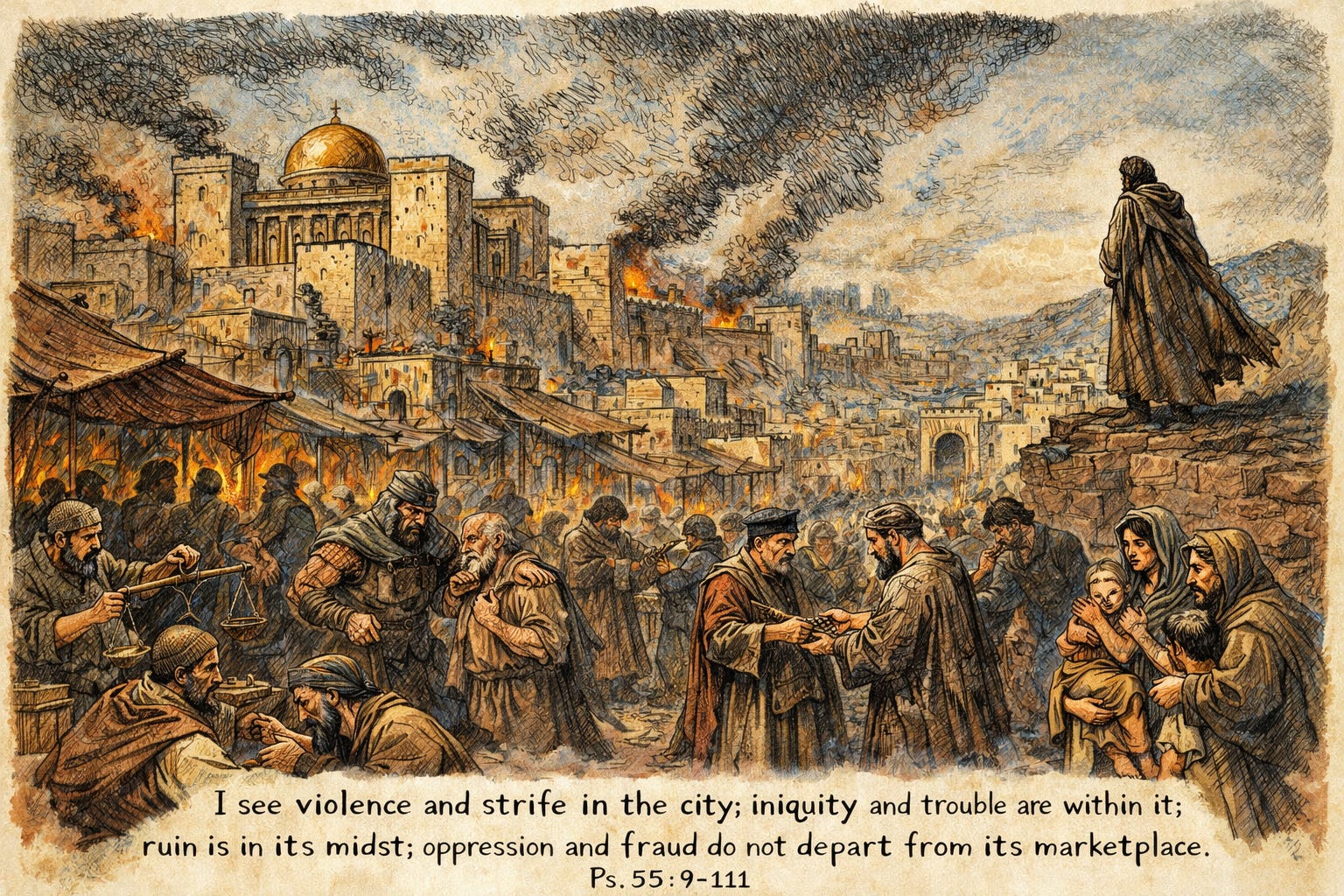
The Psalmist further describes the evils in the society. He says, “I see violence and strife in the city; iniquity and trouble are within it; ruin is in its midst; oppression and fraud do not depart from its marketplace.” (Ps. 55: 9-11)
Do you know what is happening in our cities, in our nation, in our world? Most of us don’t care to learn what is happening in our neighbourhood unless they are concerns that directly affect our lives. We never care to learn what is happening in the synod, our diocese and the parish. We want to remain clean and sanitised from all that is happening around us.
Are you concerned about the increasing abuse of children, particularly girl children? Are you concerned about the increasing violence against women, whether it is domestic violence, rape or dowry deaths? Are you concerned about the increasing violations of human rights by the state? Are you concerned about the increasing corruption in our public life?
Are you concerned about the way technology is being used to invade our privacy, to destroy life, to make profit for multinational corporations? Are you aware of how communalism and sectarianism has crept into our body politic and destroyed the fabric of our civilisation? Are you aware of the role that the churches in Kerala play in the political life of Kerala, undermining probity in public life and social justice for the most vulnerable in our society?
We often ignore these realities and find a safe haven in our individualistic morality and piety. Christ never would have had to face the cross if he had not confronted the religious and political forces that had become exploitative and dehumanising. This is an aspect that we as middle class Christians ignore; we ignore the societal and structural sins that control our lives, whether it be communalism, casteism, racism, patriarchy, consumerism or globalisation.
Our individual lives, their decisions, are controlled and dictated by many societal forces such as these.

While emphasising this, the Psalmist is particular that we should not lose sight of our individual complicity and participation in all these sins. In verses 20 and 21, we read: “My companion stretched out his hand against his friends; he violated his covenant. His speech was smooth as butter, yet war was in his heart; his words were softer than oil, yet they were drawn swords.”
What is in one’s heart is most intimate and confidential; it is most private. Language is expected to be an expression of what is in one’s heart and in one’s thinking. However, the human mind is clever in hiding its deepest feelings and drives, exhibiting the opposite. Psychologists share a common ground in acknowledging this fact.
Our ‘speech’ and ‘words’ can be as soft as butter or oil, but they are often subterfuges, deceptive strategies that hide our real feelings and intentions. Extreme religiosity and pacifism may be a cover-up, a defence mechanism, to hide our real feelings for revenge and violence.
Our extreme postures against sex education in schools and any sort of friendship between boys and girls, and our insistence on dress codes for women and moral policing, can be a cover-up to hide our unconscious and deep-seated sexual feelings and drives, which we consider as bad. War begins in our heart. Intolerance begins in our heart.
So we all chant, ‘hang! hang! the rapists’. We all forget that there is a rapist in all of us. How are we going to reform ourselves?
The moral police of the Jewish society, the teachers of the law, and the Pharisees, brought in a woman caught in adultery to find out how Jesus would respond to this moral turpitude. We all know Jesus’ response; Jesus told them, “Let any one of you who is without sin be the first to throw a stone at her.”
We further read, “At this, those who heard began to go away one at a time, the older ones first, until only Jesus was left, with the woman still standing there.”
This will be the same response that Jesus would make to those who put the onus of rape on the victims of such atrocity, accusing them of their inappropriate dress and so on. Before we condemn, judge, convict and hang people, let us all acknowledge that there is war, revenge, and rape in all of us.
In Matthew Ch. 5: 27, we find Jesus’ definition of adultery: “You have heard that it was said, ‘You shall not commit adultery.’ But I tell you that anyone who looks at a woman lustfully has already committed adultery with her in his heart.”
If this is the truth, how can any of us escape from the sin of adultery? This awareness would help us to:
face our innermost feelings honestly;
deal with them consciously, more realistically and rationally; one does not have to repress them;
be more understanding and sympathetic towards those who have become victims of their own uncontrolled passions; and
put in place strategic educational and correctional steps and laws that would prevent such things from repeating.
This would also make us more humble, repentant, understanding and loving. Hate can only breed hate; and that is why we have the dictum of Jesus: “love your enemies and pray for those who persecute you.” (Matt. 5:44)
As we approach the cross, let us be aware of the fact that we are all implicated in the cross of Christ. It is our sins that crucified Jesus: sins in our innermost hearts and sins that tenaciously cling to our societal and institutional structures; evil in our homes and in our hearts.
The Prophet Isaiah, when he had a vision of “the Lord high and exalted seated on a throne”, acknowledges and cries out: “I am ruined! For I am a man of unclean lips, and I live among a people of unclean lips, and my eyes have seen the King, the LORD Almighty.”
Focusing on individual sins and ignoring their societal expressions in our collective life can only make us guilty. Guilt does not do any good to us except that it would make us self-defensive or distressed, or drive us to escape into our sanitised world of individualistic piety and self-righteousness.
At the same time, focusing on structural and societal sins while ignoring our sins as individuals would only make us self-righteous, arrogant, judging and condemning others.
Let this Lenten season be an occasion for us to be aware and to repent of our individual and corporate sins, and submit ourselves in all humility to God’s transforming love and work towards shaping this world according to God’s design. This commitment would make the experience of the cross real to us.
We must be able to say like Isaiah, “I am a man of unclean lips, and I live among a people of unclean lips.” Then we can be better followers of Christ; we can take up our crosses and follow him; not by denying evils in our individual and collective lives, but dealing with them with courage, relying on the love, mercy and grace of God in Jesus Christ.
In that grace, we must be able to reach out in love to a world that is badly bruised and broken, with the touch that binds and heals.
The Psalmist closes with this exhortation:
“Cast your cares on the LORD and he will sustain you; he will never let the righteous be shaken.” (Ps. 55:22)