
Today, following Christ is all about meeting the requirements of middle class respectability; the effort of the churches today is not to call people for radical obedience, but rather to domesticate them to be good and respectable church members.
We demand from ourselves and our children not to take Christ too seriously, but to be good church people, live morally decent lives, and not meddle in the affairs of the world as Jesus did.
Be studious in your studies; get a lucrative job; pay the tithe; have a successful married life; ensure a good bank balance; of course, take care of your parents; and if you still have some pangs about the sort of life that you are living and are touched by the sermons of a preacher or teacher about ultimate matters of life, give a good sum of money to some missionary work or give generously to the Church.
The young man in this story is shaped to be the embodiment of all that is part of middle class values and respectability: he lives in the world of ideas; he is capable of asking very important and pertinent questions that refer to ultimate matters in life: “What good thing must I do to get eternal life?” But certainly he is not prepared to take any direction from Christ that would make an absolute claim on his life.
Mark describes his eagerness, urgency and apparent commitment in these words: “a man ran up to Him and knelt before Him, and asked Him, “Good Teacher, what shall I do to inherit eternal life?” (Mk. 10.17) Luke further describes him as “a certain ruler.” (Lk. 18.18) Whatever be the specific meaning of ‘ruler’, it is certain that he is a man who has established certain power and status in the community at a very young age. He is rich, young, successful, and a ruler and of decent character: he has observed all that is required of him by the law of Moses, especially those laws that concern one’s relationship to fellow human beings: “You shall not murder, you shall not commit adultery, you shall not steal, you shall not give false testimony, honour your father and mother’, and ‘love your neighbour as yourself.’” (Matt. 19: 18-19)
It is with a certain amount of self-congratulation that he asks Jesus, “All these I have kept,… What do I still lack?” It seems to me that he expected words of congratulation from Christ and that Christ would assure him of eternal life. Are we not in the same situation as this rich young ruler? What do we lack? We have not murdered anybody, we have not committed adultery, we have not stolen anybody’s property, we honour our parents. We have always been concerned about eternal life and have been eager to learn more about it. Yet, what do we lack?
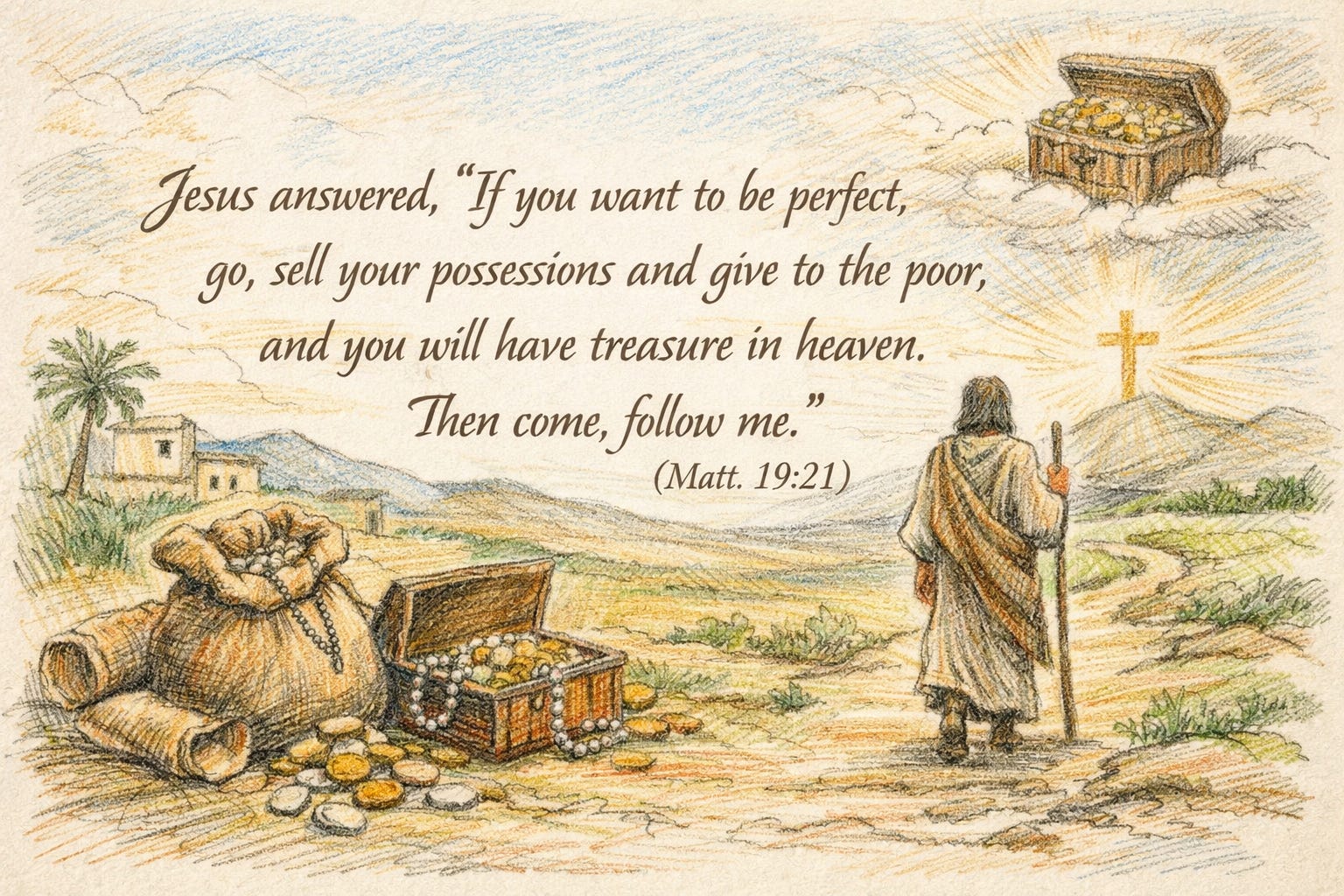
Jesus would, I believe, say the same things that he said to this rich young ruler: “If you want to be perfect, go, sell your possessions and give to the poor, and you will have treasure in heaven. Then come, follow me.”
This statement implicates, incriminates, and accuses the rich young ruler and all of us on the following counts:
Like the rich young ruler, we forget the definition that Jesus gave to “murder” and “adultery”. “You have heard that it was said to the people long ago, ‘You shall not murder, and anyone who murders will be subject to judgment.’ But I tell you that anyone who is angry with a brother or sister will be subject to judgment. Again, anyone who says to a brother or sister, ‘Raca,’ (worthless) is answerable to the court. And anyone who says, ‘You fool!’ will be in danger of the fire of hell.” (Matt. 5: 21-22)
“You have heard that it was said, ‘You shall not commit adultery.’ But I tell you that anyone who looks at a woman lustfully has already committed adultery with her in his heart.” (Matt. 5: 27-28)
Even if we follow the commandments, none of us can claim any moral perfection; when so many of our brothers and sisters live in poverty and hunger, when 40 children out of 1000 die in India within the first year of birth, so many die without proper medical care while we wallow in affluence, we are guilty of murder.
Our complicity in perpetuating such an unjust situation cannot be ignored. As someone has said, “we commit the sin of eating four times a day.” We cannot absolve ourselves; but we continue to feel that we are morally perfect. We have no qualms about being part of a church and a society that is callously blind and indifferent to the injustices that happen around us. We block the world, this earth, and our fellow human beings out of the purview of our responsibility.
Middle class morality, our religiosity, often covers up crass selfishness on our part. It lets us feel self-righteous, morally perfect, not-like those-urchins, while we have been only preoccupied with our comfort, our wealth, our salvation. The rich young ruler could not place his morality in the larger context of his relationship and responsibility to this earth, its flora and fauna and the fellow human beings.
About this young man, the synoptic gospels have this to say: “When the young man heard this, he went away sad, because he had great wealth.” (Mt. 19:22) The problem with this young man was that he was too attached to his wealth that he could not extricate himself from his material possessions; he was not ready to part with his wealth for what he himself was seeking after, eternal life.
He went away grieving, sad. He allowed material possessions to have dominion over his life; God was edged out of his life without he himself knowing it. His religiosity was only a cover up. Jesus made it clear at the beginning of his ministry itself, “No one can serve two masters. Either you will hate the one and love the other, or you will be devoted to the one and despise the other. You cannot serve both God and money.” (Matt. 6:24)
Middle class religiosity is a byproduct of our striving to live with both God and money. Hence the call, “sell all”.
“Sell all” - the specific nature of this command differs from person to person and situation to situation. For one who has enthroned power and prestige in the place of God, and who worships the vestiges of power, ‘sell all’ would mean to leave such positions and remain in solidarity with the vulnerable and the powerless.
For one who is so engrossed in his or her beauty, the ‘sell all’ may mean, to leave his preoccupation with his or her own looks and to serve those who are disfigured and lost and even deprived of their humanity. For those who are engrossed in knowledge creation and associated power and prestige, ‘sell all’ would mean to put knowledge in the service of humanity.
‘Sell all’ means a radical reorientation, a total change in one’s life that one is made a tool in the hands of God to be used for His glory and in the service of life. The radical nature of one’s discipleship to Christ is repeatedly brought out in the gospels: “If anyone comes to me and does not hate father and mother, wife and children, brothers and sisters - yes, even their own life - such a person cannot be my disciple.” (Lk. 14:26) We must leave all, sell all.
But this selling all would not be sufficient and we cannot stop there; we must follow Christ. Then, “Follow me”. We must follow Christ; Christ is our model. We must follow Christ on the way of the Cross. It is a way of solidarity with all those who are excluded; it is a way of immersing oneself in this world of sin to redeem it; it is a way of taking responsibility for the suffering caused by human sinfulness. It is a way of being there for the other.
Following Jesus means to die to oneself and to have Christ living in us. As Paul writes to the Galatians, “I have been crucified with Christ and I no longer live, but Christ lives in me.” (Gal. 2:20)
Dietrich Bonhoeffer, one of the greatest theologians of the twentieth century, who was martyred for his part in the conspiracy to assassinate Adolf Hitler, stated in his book, The Cost of Discipleship: “When Christ calls a man, he bids him come and die. It may be a death like that of the first disciples who had to leave home and work to follow him, or it may be a death like Luther’s, who had to leave the monastery and go out into the world. But it is the same death every time—death in Jesus Christ, the death of the old man at his call.” (p. 99)