
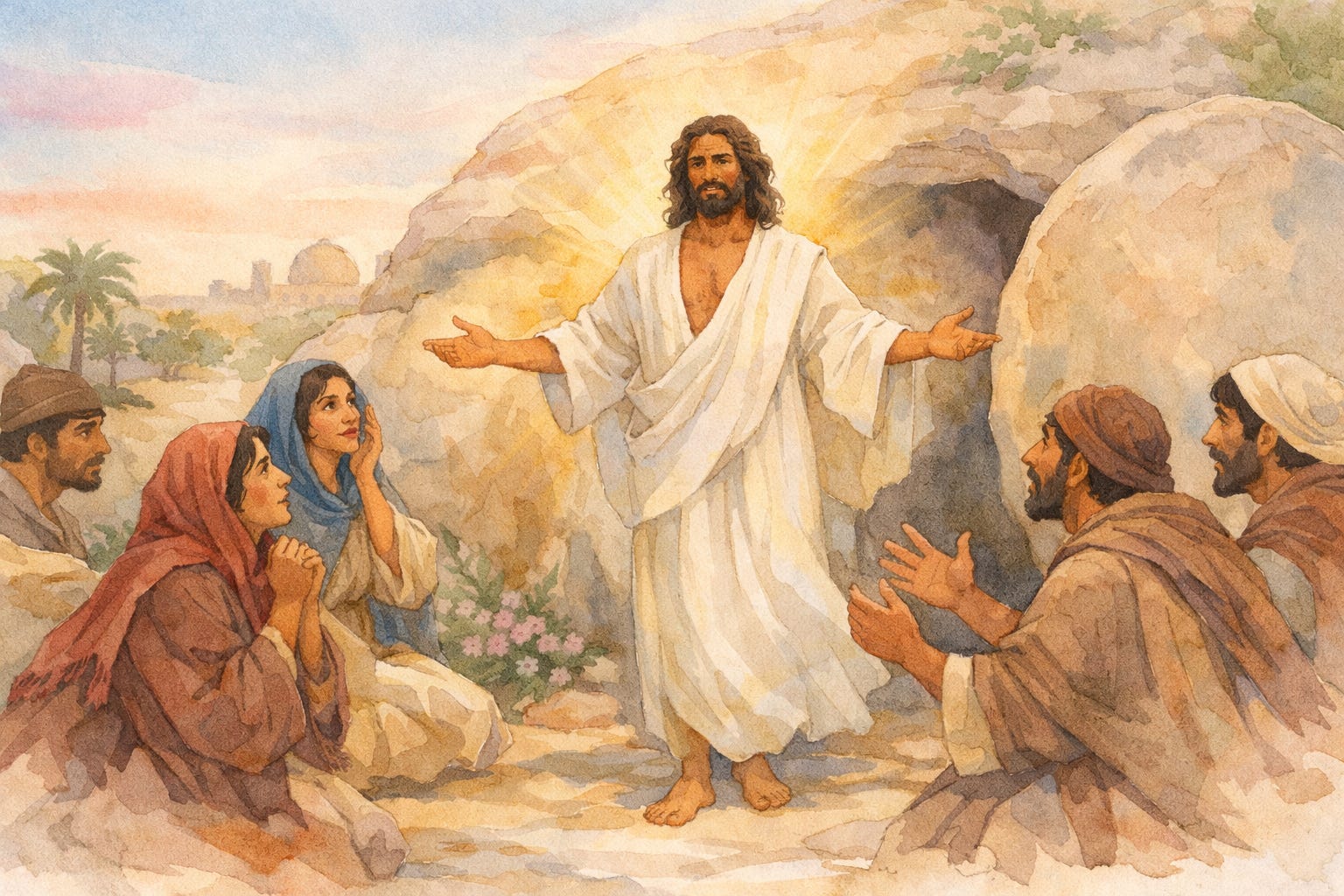
Jesus Christ is risen! Halleluiah! Yes he is risen indeed!
There is a story about a pastor who took his pastoral responsibility very seriously. He would move around everywhere, seeking his lost sheep. Once, he entered a pub and found three men sitting at the bar. He asked the first, “Do you want to go to heaven?” The man said, “yes”. The priest said, “Then go stand against the wall.” He asked the second if he wanted to go to heaven. The man said, “yes”, and the priest told him also to stand against the wall. He asked the third, “And you, do you want to go to heaven?” The man said, “no.” The priest was taken aback; he asked, “What? When you die, you don’t want to go to heaven?” The man said, “Well, yes, when I die. But I thought you were getting a group to go right now!” Many of us are like this third person in the story. We want to go to heaven when we die, not today.
What is the resurrection of Christ all about? What is Easter all about? Has it got any significance in the here and now, whilst we live on this earth? Or is it significant only after our death? The resurrection of Christ is not about a heaven after our death, but it is about living a life victorious over sin and death. What are the implications of Christ’s resurrection for our life in the world, here and now?
First, it assures us that it is not all over yet. We are living in a world of sin and death. Satan and the princes of this world seem to have their free reign over this world; they seem to trample upon human lives and God’s beautiful creation. We feel hemmed in, unable to make any headway, lost and surrounded. The resurrection announces that they do not have the final say; the final say is for Christ and his people; it is for God’s kingdom.
God, by raising Jesus, His son, from death, has unleashed the forces of a new life that works toward peace, justice and fullness of life. We have been given victory over sin and death. We read in 1 Peter 1: 3, “Praise be to the God and Father of our Lord Jesus Christ! In his great mercy he has given us a new birth into a living hope through the resurrection of Jesus Christ from the dead.” We are filled with a living hope. It is not all over yet.
In a world of sorrow, pain and ultimately death, it is not over yet. Easter is indeed a forceful reminder that the human spirit cannot be confined. It does not deny the reality of death, but it offers us an assurance that death or death dealing forces do not have the final word.
With the death and resurrection of Jesus of Nazareth, the earth has been shaken up, the new rule of God has been proclaimed, so that despite appearances, the world is in fact a different place, full of new possibilities, previously unimagined.
Paul explains in his letter to the Colossians the reality of being raised with Christ: “Since, then, you have been raised with Christ, set your hearts on things above, where Christ is, seated at the right hand of God. Set your minds on things above, not on earthly things. For you died, and your life is now hidden with Christ in God. When Christ, who is your life, appears, then you also will appear with him in glory.” (3: 1-4) Even whilst we are on this earth, we can be part of this resurrection order of existence, we are given this experience of being raised with Christ, so that our minds and hearts are set not on earthly things, but on things that are above. We are controlled and guided by heaven; our citizenship is in heaven.
Second, resurrection provides us with a new meaning for our life. Dietrich Bonhoeffer, in Letters and Papers from Prison, wrote about the meaning of Easter: “Good Friday and Easter free us to think about other things far beyond our own personal fate, about the ultimate meaning of all life, suffering, and events; and we lay hold of a great hope.” Life has a purpose and meaning beyond our personal successes and failures; God has a plan for us and His creation.
It may involve privations and disappointments, but whatever the cost, it will be worth it. Jesus Christ is risen from the dead. Eternal life begins now. “I am the Resurrection and the Life.” We are part of a new reality, new life in Christ. Whilst in that horrible prison, Bonhoeffer wrote: “As I see it, I am here for some purpose and I only hope I may fulfil it. In light of the great purpose, all our privations and disappointments are trivial.” Life takes on a new meaning.
Without this meaningfulness, we are as good as dead. Death is not physical cessation of breath, but it is a state of having no meaning or purpose for living. If you are possessed with this understanding, death ceases to have any control over our life.
Hence, in Paul’s first letter to the Corinthians, he writes, “Where, O death, is your victory? Where, O death, is your sting?” The sting of death is sin, and the power of sin is the law. But thanks be to God! He gives us the victory through our Lord Jesus Christ. (15: 55-57)
The sting of death is our fear of death. It is fear of death that causes us to hold on to life and become selfish; it causes us to be forgetful of and indifferent to the sufferings of others; we try to secure our life in panic by hoarding and accumulating. We move away from our God-given destiny; that is sin. But ultimate meaningfulness of life, which enabled Christ to declare on the cross, “it is finished”, drives away all fear of death; and death’s sting has been taken away, and we can now live a life victorious over sin and death.
That is the experience of eternal life. That is the experience of true freedom.
Lastly, the resurrection of Jesus provides us with the assurance that the way of the cross is the true path to all human and cosmic quest for liberation. We tend to think that the cross was a temporary defeat and that the resurrection was the real moment of victory. But, the cross was the victory and the resurrection was merely the visible proof and public vindication of the victory on the cross.
Resurrection does not do away with the cross; rather, it affirms that the way of the cross, the way of suffering love, the way of being responsible for one’s fellow human beings and creation, is the most legitimate way for living meaningful lives, for solving the problems of this world and for the liberation of this world. God, by raising Jesus from the dead, has given his stamp of approval to the way that His Son, Jesus Christ, has opted for, a way of dying to give life.
Jesus said, “Very truly I tell you, unless a kernel of wheat falls to the ground and dies, it remains only a single seed. But if it dies, it produces many seeds.” The Cross embodies this way, the way of dying to give life to others. It is a very costly way; it is not the way of miracles. “For you know that it was not with perishable things such as silver or gold that you were redeemed... but with the precious blood of Christ, a lamb without blemish or defect.” (1 Pet 1: 18-19).
Jesus did not shy away from any situation of human disfigurement and disintegration of life. Jesus acted in responsibility to his fellow humans and the earth; he refused to budge before the death dealing forces of his time, be it religion, culture or politics.
In this, he remained resolutely in solidarity with the poor, those who were pushed to the margins of our society. He brought them wholeness and healing. In short, “he took up our pain and bore our suffering”; he showed us love in action, not love in the abstract. This style of life, way of life, made the cross inevitable.
The cross remains as the embodiment of the power of love and its victory over all that disfigures God’s beautiful creation. The Resurrection of Christ is God’s way of declaring the way of the cross as the only way to liberate this world. This message is powerfully encapsulated in the poem/hymn written by James R Lowell, titled ‘Once to Every Man and Nation’. The last stanza concludes as follows:
Though the cause of evil prosper, Yet the truth alone is strong;
Though her portion be the scaffold, And upon the throne be wrong;
Yet that scaffold sways the future, And behind the dim unknown,
Standeth God within the shadow, Keeping watch above His own
“Yet that scaffold sways the future” – Yes, the Resurrection bears witness to it. Succeeding generations of Christians bore witness to it and even faced the gallows singing praises to God. And we, who are given the privilege to be part of this resurrection faith, are called to bear witness to this reality and experience its power to transform the world.