
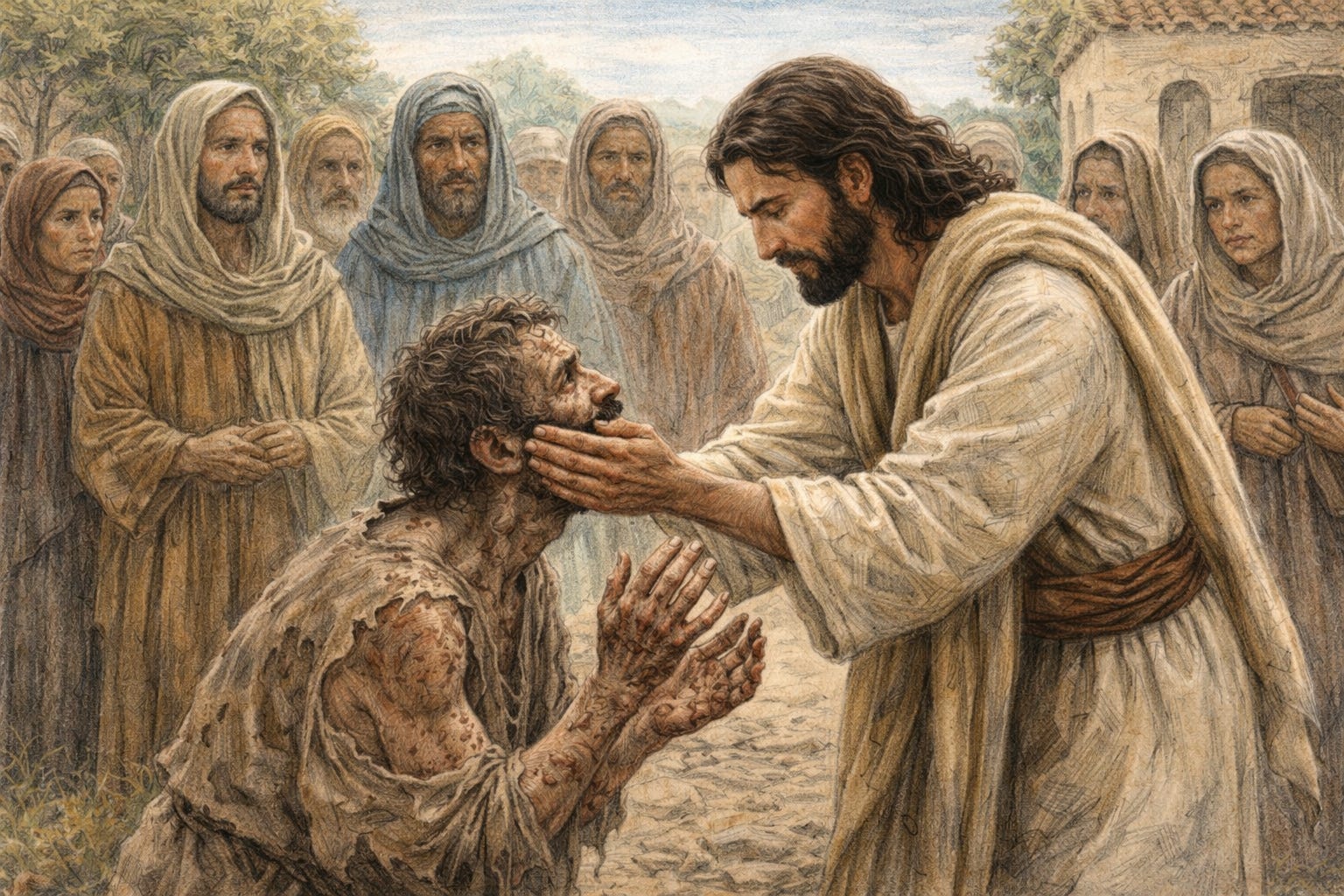
While Jesus was in one of the towns, a man came along who was covered with leprosy. When he saw Jesus, he fell with his face to the ground and begged him, “Lord, if you are willing, you can make me clean.” Jesus reached out his hand and touched the man. “I am willing,” he said. “Be clean!” And immediately the leprosy left him. Then Jesus ordered him, “Don’t tell anyone, but go, show yourself to the priest and offer the sacrifices that Moses commanded for your cleansing, as a testimony to them.” Yet the news about him spread all the more, so that crowds of people came to hear him and to be healed of their sicknesses. But Jesus often withdrew to lonely places and prayed. (Lk. 5: 12-16)
Jesus called the fishermen – Simon, James and John – to fish for people rather than continue their traditional livelihood of fishing in deep waters. From now on they were to cast their nets in a different sea, the sea of humanity in need of God. Subsequently, as Jesus continued his journey through the villages of Galilee, he came across a person suffering from a severe case of leprosy.
He prostrated himself before Jesus. More than the physical distress and deformity, a leper suffered from extreme social isolation or marginalisation. He was expected to live outside the camp. He was permitted no human contact of any sort. He was feared, despised, neglected and scorned.
But, the worst was his spiritual isolation. He was labelled as a sinner and beyond the pale of God’s love and grace. He was denied a share in the promises of God to God’s people. Their despicable situation was attributed to their sins and the resultant punishment from God.
There were a lot of people in the Jewish community who were kept out of the pale of God’s grace. This included the poor, the disfigured, and those who engaged in specific occupations that were considered to be menial. The disciples were asked to preach the good news of God’s coming rule to this group of people (minjung-multitude) who were marginalised from mainstream Jewish society: the poor, the blind, the lame, the lepers, and the tax collectors.
The leper prostrates before Christ and begs him, “Lord, if you are willing, you can make me clean.” “If you want to, you can cleanse me.”
He did not doubt Jesus’ ability to heal. He had strong faith in Christ’s power to heal and cleanse. But the question before him was whether Christ would be willing. Would Christ be willing to cleanse a god-forsaken person, a person cursed by God, a sinner like him, a wretch like him? Here we find his strong faith as well as his humility. He acknowledges his unworthiness for the grace of God. If you would be willing, you can cleanse me.
Jesus replies, “I am willing. Be clean!” Jesus’ acts of healing, cleansing, making people whole, were acts of compassion rather than an exhibition of his power. Unfortunately, we give so much emphasis to the miraculous aspect of Jesus’ ministry of healing that we fail to appreciate the compassion with which Jesus reached out to them. The Church today does not lack power. We have economic power, social power, and political power. But what we lack is willingness. The Christian history is not the story of people with power, but it is the story of people who willingly surrendered themselves to be channels of God’s grace to those who are suffering, desolate and deprived.
Love and power, compassion and might are combined in the person of Christ. Never separate the two. Love without power is only a sentiment; power without love becomes violent.
Jesus’ compassion was not just that of the heart. It was demonstrated in action. Jesus reached out his hand and touched the leper. He was willing to be unclean and put himself at the risk of infection. Jesus’ healing and cleansing acts were acts of identification with sinful humanity and bearing the burden of their sin and guilt. They were acts that cost Jesus dearly. Jesus paid with his life. Jesus was crucified by the religious people of his time because of his identification with the people whom they considered despicable and lost.
More than anything else, what the leper was craving for was this loving touch, something that had been denied to him the most. There were occasions when Jesus healed with just a word. He also could heal from a great distance, without a word or touch. Jesus recognises and responds to the deepest need of this man. He was craving for love; a human touch.
Henry Nouwen, a Dutch-born Catholic priest and spiritual writer, who served among HIV-AIDS victims and orphans, wrote in one of his books: “How little do we really know the power of physical touch. Those boys and girls only wanted one thing: to be touched, hugged, stroked, and caressed. Probably most adults have the same needs but no longer have the innocence and un-self-consciousness to express them. Sometimes I see humanity as a sea of people starving for affection, tenderness, care, love, acceptance, forgiveness and gentleness. Everyone seems to cry, ‘Please love me’.” This is the hunger Jesus recognised in the leper: not merely the restoration of health, but the restoration of being held, known, and wanted.
Once again, Jesus acts with deep insight into the man’s psyche. Jesus makes it clear that this act of cleansing will not be complete without him being taken back into the community. What he lost was his community. Jesus’ ministry is one of restoring broken relationships; it is one of reconciliation. It is more than restoring the brokenness of the body. Jesus asked this man to show himself to the priest and do the required sacrifices as a proof that he was healed and thus eligible to be incorporated into his community.
Finally, Jesus is insistent on keeping this incident a secret and not making it a matter for people to rally around him. Jesus commands, “Don’t tell anyone” of this incident. The reason behind this was that Jesus did not want a mob response to the miraculous aspect of this incident or his own power to heal. For him, it was an act of compassion and not a publicity stunt. He knew that he should eschew sensationalism. In the beginning of Jesus’ public ministry, this was one of his temptations: use miracles as a way of enticing people to follow him. Jesus wants to stay clear of the theatrics of doing ministry.
Yet the act of healing was never intended to stand alone. Jesus never wanted the cleansing of the leper to be an end in itself. What he wanted was to emphasise its significance as a sign; a pointer to the fulfilment of the promised kingdom of God. Jesus advised the disciples of John to go and report back to John what they had seen and heard: “The blind receive sight, the lame walk, those who have leprosy are cleansed, the deaf hear, the dead are raised, and the good news is proclaimed to the poor” (Lk. 7:22) as a sign that he is the promised Messiah.
This same call reaches us now. Today we are called upon to continue this ministry to the marginalised and socially isolated, and those who are treated as insignificant by others from a worldly point of view. Our ministries are truly Christian only when they are intended to reach out to the most marginalised in our society: those of our brothers and sisters whom the society considers as outcasts and of no significance. Again the question is not whether we have the money and the power, but the question is of our willingness. Do we have the will?