
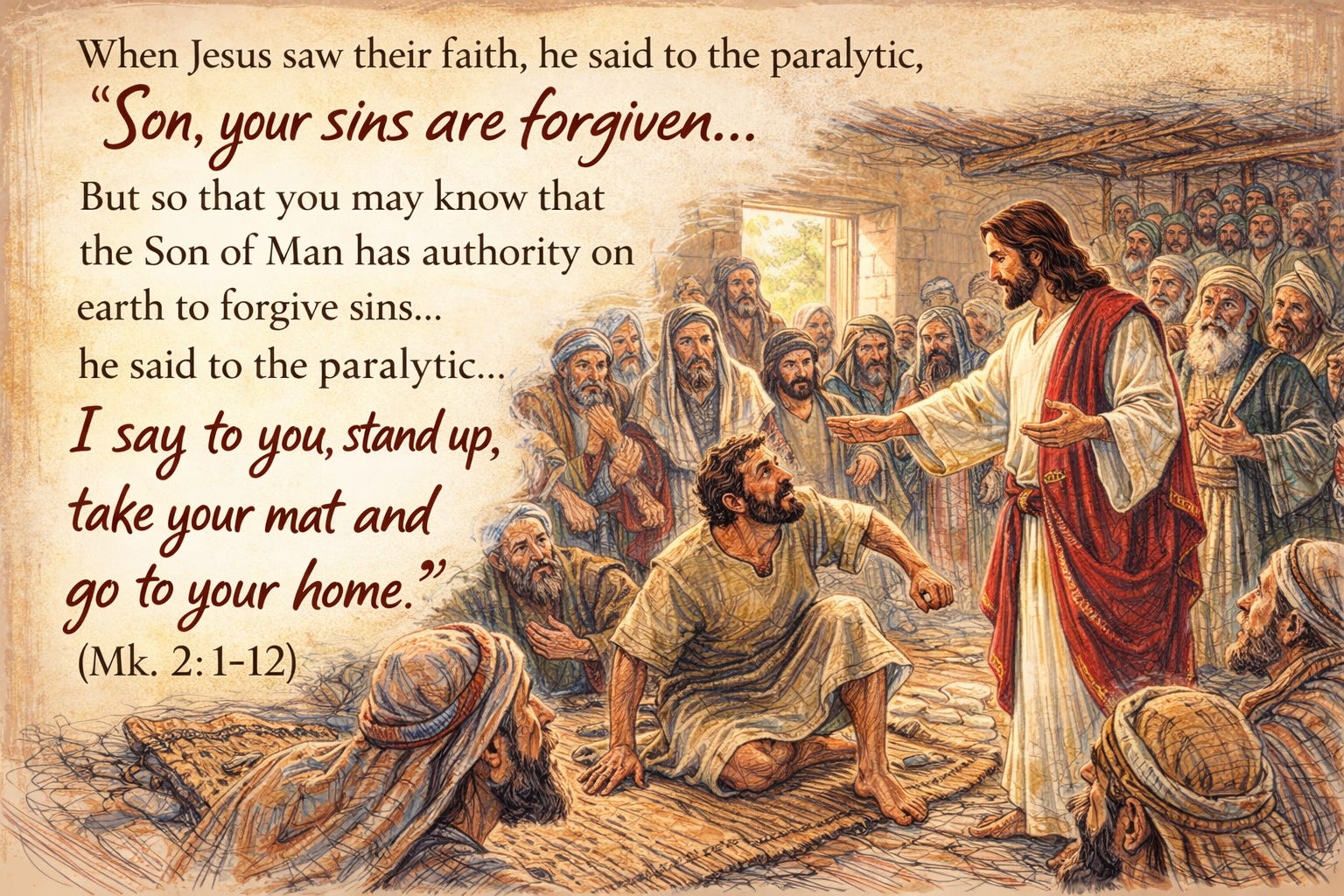
We often reduce Jesus into a miracle worker; particularly as one who performs miracles of healing. The Greek word for healing implies making whole, restoring wholeness. It cannot be confined to granting physical healing alone. It means restoring God’s creation to the wholeness that God intends for it; it means salvation.
Ten lepers came to Jesus, he healed them all; but only one, a Samaritan, returned to thank Jesus. Ten lepers were healed but only one was saved.
The Jews and most of the people in Jesus’ time believed that all kinds of suffering were the result of sin, an evil spirit working in creation. Hence, they practised exorcism. Sickness, deformity, poverty, etc. were considered to be the result of demons tormenting human beings. It was assumed that they were demon possessed because they were sinful and hence, cursed by God.
Hence, in Jesus’ time, a physically sick person not only suffered in physical terms, but also had to go through the mental agony of being forsaken by God, cursed by God. They also encountered social isolation as sinners, and were never allowed a place in the mainstream society of the righteous; they were not allowed to enter the sacred precincts of a temple.
Hence, true healing would involve not only physical healing but also social inclusion, including them into the social fold; that is, providing them with an assurance that their sins have been forgiven and hence, they belong to the community of God’s people. This is the context in which Jesus extends forgiveness to the paralyzed man: “Son, your sins are forgiven.”
Jesus also made it clear to the scribes that it was more difficult to forgive sins than to make the paralytic to stand up and walk.
Sin is a breach in the relationship that God intends for us, between God and human beings, between human beings and nature, and among human beings. God expected this relationship to be one of love: care and concern for each other; mutuality is the watchword.
A breach in any part of the relationship will have repercussions in the other parts too. If you harbour hostility to your brother, it will affect your physical health and psychological health. Your psychological stress due to wrong priorities in life will have a corresponding effect on your physical health.
We become fully functioning individuals, we become truly free only when all our relationships are set right and restored to harmony. This is salvation and this is fullness of life; Jesus’ ministry was to restore our relationships to what God intended them to be.
Sin and the breach associated with it develop in two ways.
Our sense of guilt can drive us away from God and fellow human beings as it did in the case of Adam and Eve. They tried to hide from God in guilt and shame. Guilt need not have an external basis to it. It is a feeling; it can be the result of an extremely puritanical society and the consequent development of a very rigid conscience.
When society and significant others label a person as a criminal or a sinner, he or she is also likely to label himself or herself as bad. This creates a vicious circle of moving further and further away from the society of the so-called decent and respectable people. Society excludes them and as a result, he or she will also exclude himself or herself.
There are times when we cannot forgive ourselves. This would make us distance ourselves from those who apparently are judged as good and decent by the mainstream society. To those who suffer from guilt, Jesus offers his love and forgiveness as he did in the case of the paralytic.
We are also called to extend forgiveness to all those who are trapped in their guilt. They can be freed from their isolation and guilt only by extending Christ’s forgiveness to them, what psychologists would call “unconditional positive regard”. This is what Jesus did.
Jesus told the woman who was caught in adultery: “Neither do I condemn you. Go now and leave your life of sin” (Jn. 8:11).
Jesus told the guilt ridden Zacchaeus: “Zacchaeus, hurry and come down; for I must stay at your house today.” (Lk. 19:5) Zacchaeus’ life was radically altered. He realized what it is to be a child of God and he found the joy and freedom associated with it.
Jesus forgave the sinful woman, by accepting her generous and profuse love expressed in washing his feet, drying them with her hair, pouring very costly perfume on his feet and kissing them. Jesus told her “Your sins are forgiven” “…your faith has saved you; go in peace.” (Lk. 7: 48-50)
Jesus’ ministry can be summed up in two activities: driving out demons and healing the sick, restoring wholeness to human lives and also to the rest of creation, for death and suffering are the result of sin.
Salvation would essentially involve driving out the demons: economic, political, social and cultural forces that disrupt and destroy God’s order in creation and thus bring about death. It would also involve healing, mending broken relationships, restoring the order in creation to what God designed it to be.
These are the works of salvation that Jesus would like us to continue. The centrepiece of the work of salvation is forgiveness; the much talked about secular synonym for forgiveness is inclusion: the unconditional acceptance of the other as he or she is.
During our worship service, and just before the beginning of the breaking of the bread, we offer the kiss of peace; we offer forgiveness to each other and commit ourselves to be the one community of Christ and also to continue the reconciling ministry of Christ in the world: the ministry of extending God’s forgiveness to others.
Jesus was accused of blasphemy by the scribes because he extended his ministry beyond mere physical healing to giving the paralytic a sense of belonging and acceptance, a sense that he was loved. We are also likely to face similar threats when we extend healing beyond physical healing to inclusion of all who are left out in the race of life.
Today, our ministry should extend beyond physical healing, important as it is, to works of political and social transformation that would include a lot of people who are excluded and disempowered economically, politically and socially. Bonhoeffer once stated, “We are not to simply bandage the wounds of victims beneath the wheels of injustice, we are to drive a spoke into the wheel itself.”
Globalisation, as an economic process of liberalisation, is inherently one that excludes; those who have no economic and cultural assets and hence cannot compete in the market; they will lose out and be left out.
There is a quotation from an unknown author: “I asked Jesus, ‘How much do you love me?’ And Jesus said, ‘This much.’ Then He stretched out His arms and died.”
His out-stretched arms on the cross invite all people to his fold of love; while on the cross, he prayed to his heavenly father to forgive his tormentors, he included the repentant criminal in his retinue; he gave a new family to his beloved disciple and his mother.
The forgiveness of Jesus has individual and social dimensions. We are forgiven sinners; and we are called to extend this forgiveness to others around us. This demands from us a new attitude to capital punishment, to criminals, to alcoholics and drug addicts, to people of different sexual orientations, prostitutes and to people who are different from us.
Ultimately, Jesus’ forgiveness is the cornerstone on which God’s kingdom of love is built. The acknowledgement of our reality as forgiven sinners would make us humble that we would be able to extend this forgiveness to others.
There is a saying attributed to John Bradford. While watching a group of prisoners being led to execution, he said, “There by the grace of God goes John Bradford.” It is this realization of oneself as no different from the worst criminals and that one is a forgiven sinner by the grace of God in Jesus Christ, Jesus Christ paying the ransom for us, that would make us humble and forgiving to others.
Let this Lent be a season for us to experience the forgiveness of Jesus in our life and also of extending forgiveness to others who have either wronged us or are treated by our society as sinners. May God enable us to pray the prayer that Jesus taught us to pray with all sincerity, “And forgive us our debts, as we also have forgiven our debtors.”
May God enable us to live this prayer out in our daily life, by including into Christ’s fold of love, all those who are alienated from us and from God. Forgiveness brings, not only healing to the other, but also to oneself. May this season be one during which we experience this healing in our lives and also extend this healing to others around us.